Why Cross-Cultural Leadership Matters in Today's Global Business Environment

Cross-cultural leadership is the ability to guide and inspire teams from diverse cultural backgrounds by adapting your approach to respect varying values, communication styles, and decision-making traditions. In today’s interconnected world, this skill is essential for organizational success.
What Cross-Cultural Leadership Involves:
- Understanding Cultural Differences - Recognizing how values, hierarchy, and work practices vary across cultures
- Adapting Communication Styles - Adjusting between direct and indirect communication based on cultural context
- Building Trust Across Borders - Establishing credibility through both task performance and relationship-building
- Making Inclusive Decisions - Balancing consensus-driven and top-down approaches based on team expectations
- Fostering Innovation - Leveraging diverse perspectives to drive creative problem-solving
The stakes are significant. Pew Research shows that 52% of U.S. employees view diversity and inclusion strategies positively, yet many organizations struggle to achieve meaningful results. Companies such as Google and Uber have faced challenges in international markets not because of weak products, but due to overlooking cultural expectations and failing to adapt their leadership approaches.
The benefits of getting it right are substantial. Multicultural teams contribute fresh perspectives and innovative ideas that homogeneous groups simply cannot match. When leaders bridge cultural divides, they create something more powerful and dynamic than any single cultural approach. Better problem-solving, improved performance, and improved global competitiveness become achievable outcomes rather than aspirational goals.
However, the path forward is not always clear. A U.S.-based manager accustomed to direct feedback may find their approach misunderstood by team members in Asia, who may expect more indirect input and group discussion. What is effective in one cultural context can undermine trust and effectiveness in another.
I'm Zakari Wato, founder of JapanInsider, and for over fifteen years, I've specialized in guiding Western professionals through the complexities of Japanese business culture and cross-cultural leadership challenges. My work focuses on helping leaders bridge the gap between Western and Japanese business practices to achieve authentic integration and measurable success.
The Core Challenges of Managing Multicultural Teams
Leading multicultural teams is akin to conducting an orchestra where each musician plays a different instrument with a unique rhythm and melody. The potential for a beautiful symphony is immense, but so is the risk of discord. Cross-cultural leadership challenges are among the most significant problems modern leaders face, particularly as remote work and globalization transform today’s workplace. As Gallup research highlights, understanding how different cultural pieces connect is key to success.

We often encounter leaders struggling with:
- Communication barriers: Language is just the tip of the iceberg.
- Differing leadership expectations: What's respected in one culture might be seen as authoritarian in another.
- Decision-making styles: Some teams crave consensus, others expect clear directives.
- Building trust: The foundation of any team, yet built differently across cultures.
- Managing inclusion: Ensuring every voice is heard and valued, not just the loudest.
Ignoring these challenges can lead to a significant erosion of trust and respect, reduced innovation, increased conflict, and ultimately, a decline in global competitiveness.
Navigating Communication and Decision-Making Styles
One of the most immediate and impactful areas of cultural difference lies in communication and decision-making. We've seen how these dynamics play out, especially when Western and Japanese business cultures meet.
High-context vs. Low-context Communication: In high-context cultures, such as Japan, communication is often indirect and nuanced, relying heavily on nonverbal cues, shared understanding, and implied meanings. People are expected to "read the air" (空気読む - kuuki yomu) and infer messages rather than relying solely on explicit words. In contrast, low-context cultures, such as the United States, prioritize direct, explicit communication, with messages conveyed clearly and unambiguously.
Consider feedback: a U.S.-based manager may be used to quick, direct feedback, while team members in Japan might expect input to come more indirectly, perhaps through a third party or after a long period of observation. This isn't resistance; it's a difference in how respect and information are typically exchanged.
Direct vs. Indirect Feedback: In Japan, maintaining harmony (和 - wa) and saving face (面子 - menboku) are crucial. Direct criticism, especially in public, can cause embarrassment and damage relationships. Feedback is often delivered indirectly, with careful phrasing, or even through a superior who can soften the message. For a Western leader accustomed to "straight talk," this can feel inefficient or unclear. Conversely, Japanese colleagues might perceive direct Western feedback as blunt or even rude.
Hierarchical vs. Consensus-Based Decisions: Decision-making also varies significantly. In many Western cultures, leaders may encourage independent problem-solving and expect team members to voice opinions openly, resulting in a relatively quick decision by the leader. However, in Japan, decision-making often follows a bottom-up, consensus-building process known as nemawashi (根回し), where proposals are informally discussed and agreed upon with all relevant stakeholders before a formal meeting. This ensures group harmony and commitment but can appear slow to those unfamiliar with the process.
The "Effective Meetings Between Japanese and Non-Japanese" article highlights how typical Japanese meetings often proceed organically without a designated leader, which can be confusing for non-Japanese. The highest-ranking person might even sit quietly with eyes closed – a common posture to show they don't intend to dominate the discussion. This is a stark contrast to Western-style meetings where a designated leader is expected to guide discussions and clarify decisions.
Non-verbal Cues and Language Barriers: Beyond spoken words, non-verbal communication (body language, eye contact, silence) carries different weight and meaning across cultures. What is a sign of attentiveness in one culture might be interpreted as disagreement in another. And, of course, language barriers can exacerbate all these issues, making precise communication challenging.
Here's a simplified comparison:
| Feature | High-Context Cultures (e.g., Japan) | Low-Context Cultures (e.g., U.S.) |
|---|---|---|
| Communication Style | Indirect, implicit, nuanced, relies on shared context, non-verbal cues | Direct, explicit, clear, relies on spoken words |
| Feedback Delivery | Indirect, subtle, private, often through intermediaries | Direct, open, can be public |
| Decision-Making | Consensus-driven (e.g., nemawashi), slower, focus on harmony and commitment | Leader-driven or democratic, faster, focus on efficiency, and individual input |
| Non-verbal Importance | High; silence, gestures, and facial expressions carry significant meaning | Moderate; verbal clarity often takes precedence |
| Emphasis | Relationships, group harmony, long-term perspective | Task, individual achievement, short-term perspective |
The Nuances of Trust, Time, and Work Practices
Beyond communication, how cultures perceive trust, time, and work itself profoundly influences team dynamics.
Task-based Trust vs. Relationship-based Trust: In some cultures, trust is primarily built through consistent performance, reliability, and competence in tasks. Show up on time, deliver quality work, and you earn trust. This is often referred to as task-based trust. In other countries, such as Japan, trust often grows from personal relationships, shared experiences outside of work, and long-term commitment. This relationship-based trust, sometimes referred to by the Chinese term guanxi (though the concept of strong personal connections is vital in Japan as well), means that business may proceed only after significant time has been invested in building rapport and mutual understanding. A Western leader who dives straight into KPIs and contracts without building personal connections might find Japanese partners unresponsive.
Monochronic vs. Polychronic Time Perception: How we view time also shapes our work practices. Monochronic cultures (e.g., Germany, U.S.) tend to view time as linear and sequential. Schedules are strict, appointments are punctual, and tasks are generally completed one at a time. "Time is money" is a common adage. Polychronic cultures (e.g., many parts of Asia, Latin America) view time as more fluid and flexible. Relationships and current events often take precedence over strict schedules, and multiple tasks may be juggled simultaneously. While Japan is often seen as punctual, its approach to decision-making and relationship-building can appear more polychronic, prioritizing thoroughness and harmony over speed. A leader pushing for quick decisions without allowing for nemawashi can cause friction.
Varying Attitudes toward Hierarchy and Authority: In Japan, respect for hierarchy (上下関係 - jōge kankei) and seniority is deeply ingrained. Leaders are expected to provide clear guidance and direction, and questioning authority openly is generally avoided. In contrast, some Western cultures favor flatter hierarchies, encouraging open debate and challenging superiors. A leader in the U.S. might encourage independent problem-solving, while team members from other regions may expect more directive guidance. Misunderstanding these expectations can lead to a Western leader being seen as indecisive or a Japanese leader being perceived as overly authoritarian.
Mastering Cross-Cultural Leadership by Developing Cultural Intelligence (CQ)
Given these complexities, how do we lead effectively? The answer lies in developing our Cultural Intelligence (CQ). Cultural intelligence is the ability to relate to and work effectively with people from different cultural backgrounds. It’s not just about knowing cultural facts; it's about the capability to function effectively across diverse cultural contexts. Leaders with high CQ recognize that behaviors often reflect deeper values, not resistance or lack of effort.

We believe that CQ encompasses several dimensions:
- Cognitive CQ: Our knowledge and understanding of different cultures, including their values, norms, and beliefs. This is about learning what to look for.
- Physical CQ: Our ability to adapt our non-verbal behaviors, such as gestures, facial expressions, and tone of voice, to align with the cultural norms of others. This is about doing it.
- Motivational CQ: Our interest, drive, and confidence to adapt to new cultural situations and learn from new experiences. This is about wanting to do it.
- Humility: A willingness to admit what we don't know and to learn from others. As we've seen in Japan, humility is deeply valued and signals respect.
- Curiosity: An open-minded approach to exploring cultural differences, asking questions, and seeking genuine understanding. The most effective leaders step into complexity with curiosity, humility, and adaptability.
- Adaptability: The flexibility to adjust our leadership style and approach based on the cultural context, without losing our authenticity.
Strategies to Build Trust and Foster Inclusion
Building trust and fostering inclusion in a multicultural team requires intentional effort and a nuanced approach. It’s about creating an environment where everyone feels valued, respected, and psychologically safe to contribute.
- Active Listening: This goes beyond just hearing words. It means listening for subtle cues, understanding implied meanings, and confirming understanding, especially in high-context communication cultures like Japan.
- Creating Psychological Safety: Encourage open dialogue about cultural differences. Make it safe for team members to ask questions, share concerns, and even make mistakes without fear of judgment. In Japan, this might mean creating private settings for feedback or using indirect methods to solicit input.
- Transparent Decision-Making: Clearly communicate how decisions will be made. If a consensus-based approach like nemawashi is needed, explain the process and timeline. If a leader-driven decision is being made, explain the rationale.
- Celebrating Contributions Inclusively: Recognize and reward team members in ways that resonate with their cultural values. While individual recognition might be motivating in some cultures, collective recognition for group achievements might be preferred in others.
Here are some actionable steps we recommend for fostering inclusion:
- Schedule one-on-one check-ins: These provide a safe space for individual team members to share their thoughts and build personal rapport, especially valuable in cultures that prioritize relationship-based trust.
- Create space for informal team connections: Shared meals, cultural celebrations, or virtual coffee breaks can help bridge cultural gaps and build camaraderie. In Japan, after-work gatherings (nomikai) are often crucial for team bonding.
- Acknowledge contributions in ways that resonate across cultures: Understand what motivates different team members.
- Rotate meeting facilitators: This encourages different leadership styles and ensures diverse voices are heard.
- Use anonymous surveys: This can be a great way to draw out contributions from quieter team members or those who might be hesitant to speak up directly in a hierarchical setting.
- Directly invite input from quieter team members: "Taro-san, we haven't heard from you yet, what are your thoughts on this?" can be effective if done respectfully and privately.
The Role of Continuous Learning in Effective Cross-Cultural Leadership
Cross-cultural leadership is not a destination; it's a continuous learning journey. The global landscape is constantly evolving, and so are cultural nuances and workplace expectations. Leaders must accept a lifelong learning mindset to stay effective.
- Reflect on Our Own Cultural Assumptions: We all carry cultural biases. Regularly questioning our assumptions helps us understand why others might behave differently.
- Learn About Team Members' Backgrounds: Take the time to understand the cultural contexts, values, and experiences of each team member. This can be done through direct conversation, research, or cultural training.
- Seek Feedback on How Our Leadership Style is Received: Ask for honest feedback on how your leadership approach is perceived across cultures. This requires humility and a genuine desire to adapt.
- Flex Our Leadership Style: There's no one-size-fits-all approach. Be prepared to adjust your communication, decision-making, and motivational strategies based on the cultural context.
- Avoid Jargon and Stereotypes: Be mindful of language that might be exclusive or misunderstood. Challenge your own stereotypes and avoid making assumptions about individuals based on their nationality.
For leaders working with Japan, for example, understanding concepts such as honne (true feelings) and tatemae (public facade), the importance of harmony, and the value placed on long-term relationships is critical. This deep cultural understanding enables leaders to turn potential conflict into collaboration and growth.
We at JapanInsider are dedicated to helping Western clients master Japanese business, culture, and daily life. Our expertise in bridging Western and Japanese perspectives is rooted in continuous learning and adapting to the evolving cultural landscape.
To learn more about our approach and services, we invite you to explore our Japan Insider Introduction.
Leadership in Action: Adapting to Global Expectations
Effective cross cultural leadership requires understanding that leadership itself is often perceived differently across the globe. What constitutes a "good leader" in one culture might be ineffective or even offensive in another.osing your organization's core identity. We call this finding the balance between flexibility and fidelity.
- Establishing a "Third Culture": This isn't about abandoning your own culture or fully adopting another. It's about co-creating a new, shared culture within the team that blends elements from each, focused on mutual understanding and shared goals. This "third culture" becomes the operating system for your multicultural team.
- Defining Non-Negotiable Core Values: What are the fundamental principles that define your organization? Identify these clearly. While the ways these values are enacted may vary culturally, the values themselves should remain constant. For example, "integrity" might be a core value. In Japan, this might manifest as meticulous attention to detail and an unwavering commitment to honoring commitments at all costs, even if it means personal sacrifice.
- Empowering Local Leaders: Trusting and empowering local managers, especially in places like Japan, is crucial. They possess invaluable cultural knowledge and can translate organizations
Frameworks like Hofstede's Cultural Dimensions and the GLOBE (Global Leadership and Organizational Behavior Effectiveness) Project have provided invaluable insights into these variations.
Hofstede's Cultural Dimensions identifies six dimensions (Power Distance, Individualism vs. Collectivism, Masculinity vs. Femininity, Uncertainty Avoidance, Long-Term vs. Short-Term Orientation, and Indulgence vs. Restraint) that help us understand cultural differences. For instance, Japan scores high on masculinity and long-term orientation, influencing expectations around work ethic and strategic planning.
The GLOBE Project further expanded on this, studying leadership in 62 societies and identifying nine cultural dimensions. A key finding was the existence of both universally desirable leadership traits (e.g., being charismatic, team-oriented, and humane) and culturally contingent traits (e.g., being autocratic, self-protective, or status-conscious). This means that while some leadership qualities are appreciated everywhere, others must be adapted to the local context.
A Global Look at Effective Cross-Cultural Leadership
No single leadership style works everywhere. Effective cross cultural leadership involves being aware of, in sync with, and actively involved in defining, modeling, and coaching your culture and values, while also adapting your approach to fit the context.
- Paternalistic Leadership: Prevalent in some non-Western business organizations, such as mainland China, this style combines strong discipline and authority with fatherly benevolence and moral integrity. It's about a leader acting as a parent figure, providing guidance and protection in exchange for loyalty.
- Changeal Leadership: This style, focused on inspiring a shared vision, mentoring, and building trust, has shown varying effectiveness across cultures. While generally positive, its specific impact on performance and trust can differ. For example, research found that changeal leadership predicted performance and trust in Australia, but only trust in China.
- Transactional Leadership: This style emphasizes clear exchanges between leader and follower (rewards for performance, corrective action for deviations). Like changeal leadership, its effectiveness can be culturally moderated.
- Charismatic/Value-Based Leadership: Universally admired traits often include being visionary, inspirational, and self-sacrificing.
- Team-Oriented Leadership: Emphasizing collaboration, common purpose, and group cohesion, this style is highly effective in collectivistic cultures like Japan.
The Project GLOBE research provides a deeper understanding of these nuances, highlighting that leaders need intercultural competence: the ability to understand and respect other cultural norms while balancing the team’s overall goals.
Balancing Cultural Adaptation with Core Organizational Values
One of the trickiest aspects of cross-cultural leadership is knowing how far to adapt without lnal values into culturally appropriate actions.- Creating Clear Communication Channels for Value Alignment: Regularly discuss what your core values mean in different cultural contexts. How does "innovation" look in Aomori versus Tokyo, or in a Western context? These conversations help ensure everyone is working towards the same goals with a shared understanding.
- Maintaining Authenticity: While adaptation is key, leaders must also remain authentic to themselves and their organization. Insincere attempts at cultural mimicry are often transparent and can undermine trust. The most effective leaders are those who step into complexity with curiosity, humility, and adaptability, not mimicry.
The Organizational Impact of Global Leadership
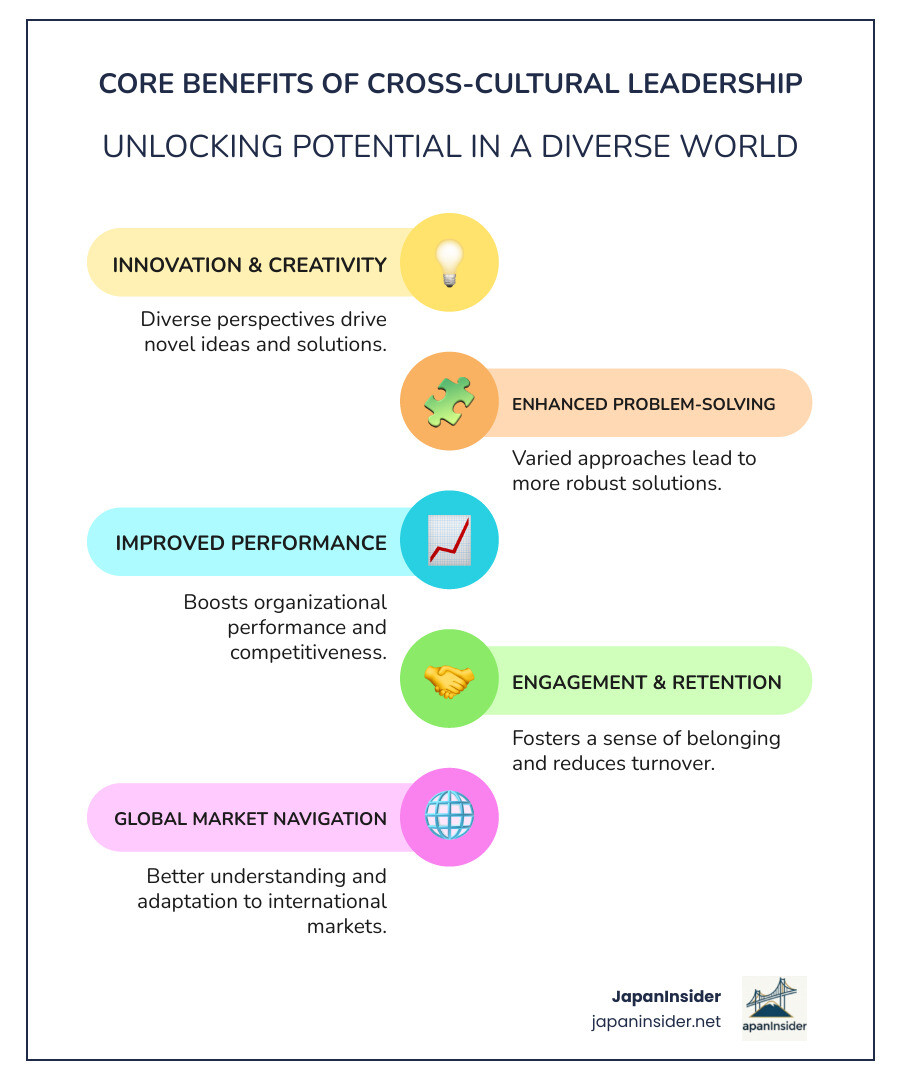
The payoff for effective cross cultural leadership is significant. It's not just about avoiding pitfalls; it's about open uping immense potential. When leaders successfully steer cultural differences, the result is more powerful and dynamic than any single approach on its own.
- Increased Innovation: Multicultural teams contribute fresh perspectives and innovative ideas. Different ways of thinking, problem-solving, and approaching tasks lead to more creative solutions.
- Better Problem-Solving: Diverse teams bring a broader range of experiences and cognitive styles to the table, leading to better problem solving. This diversity of thought allows for more robust analysis and comprehensive solutions.
- Improved Performance: When teams are inclusive and culturally intelligent, they perform better. Studies show that diverse teams often outperform homogeneous ones, leading to improved performance.
- Global Competitiveness: In today's interconnected marketplace, organizations with strong cross cultural leadership are better positioned to expand into new markets, understand global customer needs, and steer international business complexities.
- Employee Engagement and Retention: A workplace that values diversity and fosters inclusion leads to higher employee engagement and retention. When employees feel understood and respected, regardless of their cultural background, they are more likely to thrive.
Training and Developing Your Next Generation of Global Leaders
How do organizations cultivate these essential cross-cultural leadership skills? It requires a strategic and multifaceted approach to training and development.
- Cross-Cultural Training Programs: These programs are vital for building cognitive CQ. They can cover cultural norms, communication styles, business etiquette, and historical context for specific regions, such as Japan. For Western leaders coming to Japan, understanding concepts like honne and tatemae, nemawashi, and the importance of group harmony is crucial.
- Experiential Learning: Nothing beats hands-on experience. This includes short-term assignments, participation in international projects, or rotations in multicultural teams. Learning by doing, reflecting on experiences, and receiving feedback are powerful drivers of CQ development.
- Expatriate Assignments: While challenging, expatriate assignments offer unparalleled opportunities for leaders to immerse themselves in a new culture and develop deep cross cultural leadership skills. Support for these assignments, including pre-departure training and ongoing mentorship, is critical to their success.
- Mentorship Programs: Pairing emerging leaders with experienced global leaders or cultural mentors can provide invaluable guidance and insights into navigating complex cultural situations.
- Creating a Culturally Intelligent Organization: This goes beyond individual training. It involves embedding inclusive leadership practices, ensuring inclusion is not a one-time effort but a daily reality. It means adapting HR policies, communication strategies, and organizational culture to support diversity.
At JapanInsider, we offer bespoke training and development programs designed to equip leaders with the cross-cultural leadership skills needed to thrive in Japan. Our programs focus on practical application, drawing on real-world scenarios and our deep understanding of both Western and Japanese business contexts.
Stay informed about our latest insights and offerings by subscribing to our Japan Insider Newsletter.
Frequently Asked Questions about Cross-Cultural Leadership
What are the first steps to improve my cross-cultural leadership skills?
Start with self-awareness by reflecting on your own cultural biases. Then, focus on developing curiosity and active listening skills. Learn about the specific cultures of your team members through research and respectful conversation. For example, if you're working with a Japanese team, take the time to understand their communication preferences and decision-making processes.
How do I handle a conflict that stems from a cultural misunderstanding?
Address the conflict privately and calmly. Approach the conversation with curiosity, not blame. Ask open-ended questions to understand each person's perspective and the cultural values that may be influencing their actions. Work together to find a mutually respectful solution. In some cultures, direct confrontation is avoided, so you may need to facilitate an indirect resolution.
Can a single leadership style work globally?
No, research consistently shows that a one-size-fits-all leadership approach is ineffective. While some traits like integrity and vision are universally appreciated, effective leaders must adapt their communication, motivation, and decision-making styles to fit the local cultural context. What inspires a team in Aomori might not resonate with a team in Tokyo, let alone a team in another country.
Conclusion
In today's globalized world, cross cultural leadership is no longer a niche skill for expatriates; it's a fundamental requirement for any leader steering a team, whether local or remote, that includes individuals from diverse backgrounds. We've explored the primary challenges from navigating nuanced communication and decision-making styles to building trust across varying cultural expectations of time and authority. We've also highlighted the critical role of Cultural Intelligence (CQ) as the cornerstone for effective cross cultural leadership, emphasizing the importance of humility, curiosity, and adaptability.
The journey of cross-cultural leadership is one of continuous learning. It demands that we reflect on our own biases, actively seek to understand others, and flex our leadership styles to fit the context, rather than imposing a single way of doing things. The benefits are clear: increased innovation, better problem-solving, improved performance, and improved global competitiveness.
At JapanInsider, we believe that differences are where the spark of innovation lives. We equip individuals and organizations with the skills to turn complexity into clarity and differences into strengths. Our expertise in bridging Western and Japanese perspectives allows us to offer authentic, culturally sensitive solutions that empower leaders to build stronger, more dynamic teams.
Don't let cultural differences become barriers. Let them be your greatest asset.
Explore our cross-cultural consulting services today and transform cross cultural leadership challenges into your greatest advantage.

.png)
.jpeg)
.png)
.png)
No comments:
Post a Comment