2026-01-14

Japan's Leading Startup Consulting Firms: Your Launchpad for Success


           Aomori Bay: Bridging Western Innovation with Japanese Market Expertise
 

Japan's Leading Startup Consulting Firms: Your Launchpad for Success

By: Zakari Watto,
 January 14, 2026


                                  About the Author


Japan Insider is an authoritative boutique cross-cultural consulting firm that specializes in connecting Western innovation with Japanese market opportunities. Founded by Zakari Watto, a native Japanese speaker with over 15 years of international business development experience, Japan Insider has established itself as a trusted advisor for foreign entrepreneurs navigating Japan's complex startup ecosystem. Our founder possesses extensive expertise in business localization, regulatory compliance, investor relations, and corporate partnership facilitation across the Asia-Pacific region.


 Understanding Japan's Renaissance: Why 2026 Represents Peak Opportunity for Startup Success

      Japan's startup ecosystem ranks 18th globally with over $5.4 billion in investment and 10 unicorns

Japan's startup ecosystem continues its unprecedented transformation into 2026. Once dominated by entrenched corporate giants, the nation has firmly established itself as a dynamic hub for innovation-driven ventures. This evolution represents a fundamental structural change in how Japan approaches entrepreneurship and technological advancement, one that accelerated throughout 2024 and 2025.

The numbers speak for themselves: Japan now ranks 18th globally in the Global Startup Ecosystem Index 2025, up three positions year over year [StartupBlink, 2025]. Japanese startups collectively raised JPY 779.3 billion in 2024, with momentum continuing through early 2026, reflecting consistent investor confidence and sustained market expansion [Japan Dev Team, 2025]. More significantly, the nation hosts 10 unicorns as of November 2024, with additional candidates emerging through 2025-2026, demonstrating the viability of building world-class companies from Japanese soil [Smion, 2024].

Japan stands out among emerging startup hubs due to its mature infrastructure. The country offers a highly educated, English-proficient workforce, advanced technology, and sophisticated consumer markets. Startup investment surpassed $5.4 billion in 2023 and has grown steadily, maintaining a 25% increase since 2013 and demonstrating resilience through 2025-2026.

Why Western Entrepreneurs Choose Japan: The Competitive Advantage

The Strategic Gateway to Asia and the World

For Western entrepreneurs, Japan serves as a strategic gateway to Asia-Pacific markets. Its geographic location, strong infrastructure, and integration with global supply chains make it an ideal base for regional expansion. Companies operating in Japan gain regional credibility and access to advanced manufacturing, logistics, and distribution networks.

The Cultural Trust Factor

Japan's reputation for quality, precision, and reliability benefits startups that invest in understanding the local market. Western founders who respect Japanese business customs and market dynamics can access partnership opportunities with established corporations, often more quickly than in other markets.

Access to Corporate Innovation Capital

Startup Ecosystem Comparison: Japan, United States, and Singapore - Infrastructure, Talent, Investment Climate, Regulatory Environment


Corporate-affiliated venture capital reached $3.4 billion in 2023, up from $140 million a decade earlier. This shift underscores Japanese corporations' focus on innovation partnerships, creating new opportunities for startups to collaborate with industry leaders.

 The Hidden Complexity: Why DIY Market Entry Fails (And How Consulting Firms Prevent Costly Mistakes)

Navigating the Invisible Barriers

Western entrepreneurs often underestimate the complexity of Japan's business environment. Unlike English-speaking markets, Japan relies on layered communication, implicit decision-making, and relationship-based business processes. Understanding these cultural factors turns potential challenges into opportunities.

Misunderstanding the market can lead to failed entries, regulatory penalties, broken partnerships, and delayed fundraising. A single compliance error may cause months of disruption and reduce investor confidence.

The Strategic Advisor Advantage

Leading startup consulting firms act as accelerators, strategists, and risk mitigators. They align your product vision with the Japanese market, translating not only language but also intent, strategy, and competitive positioning.

 Core Service Architecture: How Elite Consulting Firms Architect Your Success

Strategic Market Entry and Business Localization

Top consulting firms conduct detailed market research tailored to your industry in Japan. Their analysis covers competitive positioning, regulatory requirements, supply chain logistics, and customer acquisition strategies specific to the Japanese market.

Your consulting partner creates a Japan-specific go-to-market strategy, adapting product positioning, pricing, and distribution to local expectations. For SaaS, this may mean adjusting your value proposition. For hardware, this involves navigating certification requirements and building relationships with retailers.

Investment Roadmapping and Fundraising Acceleration

Japan's investment landscape differs from Western models. Investors prioritize long-term sustainability, market defensibility, and realistic growth over rapid expansion. Consulting firms help tailor your narrative, financial models, and pitch strategy to these expectations.

Consulting firms connect you with relevant venture capital firms, corporate investors, and angel networks, reducing fundraising timelines. Despite global volatility, Japan's investment ecosystem grew by 3% in 2024, offering strong opportunities for well-positioned startups [Japan Dev Team, 2025].

Operational Excellence for Scalable Growth

As your startup grows, operational infrastructure is essential. Consulting firms establish Japan-specific processes for supply chain management, talent acquisition, customer support, and regulatory compliance. This ensures rapid growth without compromising quality.

Leadership Mentorship and Founder Development

In addition to tactical support, top consulting firms provide founder mentorship to address the psychological and strategic challenges of scaling in a new market. This personal development often proves more valuable than formal advice.

                                                        Consulting Firm Service Architecture: From Market Entry to Fundraising, then Operations, Leadership Development, and Sustained Growth

Specialized Expertise: Japan's Deep Technology Frontier

Generative AI and Advanced Computing

Japan's AI sector is rapidly growing, with ventures like Sakana AI advancing frontier applications. Consulting firms with AI expertise help startups position products, secure research partnerships with universities, and address ethical considerations in regulated industries.

Mobility, Autonomous Systems, and Smart Infrastructure

Japan's automotive sector is undergoing a transformation, with electric vehicles, autonomous systems, and connected ecosystems creating new opportunities. Mobility-focused consulting firms help startups develop technology, navigate regulations, and build partnerships with major companies and emerging players.

Biotech and Life Sciences Commercialization

Japan's pharmaceutical and biotech sectors are increasingly open to innovative startups. Consulting firms guide companies through regulatory requirements, facilitate university partnerships, and identify collaboration opportunities with established life sciences firms.

Internet of Things and Industrial IoT

Japan's Industry 4.0 transformation is driving demand for IoT and edge computing solutions. Consulting firms help IoT startups meet industry requirements, navigate certification, and find strategic partners in manufacturing, utilities, and innovative city projects.

 The Consulting Firm Selection Framework: Making the Right Partnership Decision

Assessing True Expertise Versus Generic Consulting

Consulting firms vary in value, depending on whether potential partners have industry-specific expertise in your technology area rather than general business advice. Proven experience with similar startups, strong networks, and founder-friendly engagement models indicate a partner's ability to deliver results and support sustainable growth.

Cultural Compatibility and Communication Excellence

The success of your consulting relationship depends on clear communication and mutual understanding. Ensure potential partners understand your vision and can articulate your strategy accurately.

Transparent Engagement Models

Japan's consulting industry, valued at USD 11.73 billion annually and projected to grow by 11.42% annually through 2030 [Mordor Intelligence, 2025], offers various pricing models. Confirm whether fees are hourly, project-based, retainer-based, or success-based, and ensure the structure aligns with your funding stage.

Long-Term Partnership Vision

The most effective consulting partnerships extend beyond the initial launch. Choose partners committed to your long-term growth and able to provide ongoing advice as your business and the market evolve.

 The Untold Cost of Regulatory Misalignment: Why Compliance Expertise Protects Your Investment

Japan enforces strict regulations across industries, including data privacy, intellectual property, labor law, and sector-specific requirements. A single compliance error can cause operational disruption, penalties, and loss of investor confidence.

Top consulting firms offer regulatory expertise, guiding startups through permits, licenses, and process alignment. This support protects your investment and accelerates operational legitimacy.

 Building Your Network Advantage: The Intangible Value of Strategic Connections

Investor Network Access

Established consulting firms have strong relationships with Japan's leading venture capital firms, corporate investors, and angel networks. These connections shorten fundraising timelines and increase funding opportunities.

Corporate Partnership Facilitation

Many Western startups miss corporate partnership opportunities. Japanese corporations are seeking innovation partnerships, especially in emerging technologies. Consulting firms position your startup for these partnerships, creating revenue and market validation alongside fundraising.

Talent Acquisition and Team Building

Building strong teams in Japan requires knowledge of local talent markets, recruitment channels, and workplace culture. Consulting firms speed up talent acquisition and help align your organizational culture with Japanese expectations.

 Digital Presence and SEO Strategy for Japan: Capturing Online Visibility

Localization Beyond Translation

Your digital strategy must be adapted for the Japanese market. This includes search engine optimization for local search, cultural content adaptation, and platform selection that aligns with how Japanese customers research solutions.

Local SEO and Market Visibility

Consulting firms implement SEO strategies focused on Japanese search queries, local directories, and industry platforms. This approach ensures your startup is visible to Japanese customers when they search for relevant solutions.

Social Media and Community Building

Japanese social media differs from Western platforms. Consulting firms guide your strategy across LINE, Twitter, Instagram, and industry-specific communities where Japanese customers are active.

 Measuring Success: KPIs and Growth Benchmarks That Matter in Japan

Japanese investors and corporate partners prioritize sustainable profitability, market defensibility, and realistic unit economics over rapid user acquisition and aggressive growth.

Consulting firms help you develop KPI frameworks aligned with the expectations of the Japanese stakeholders. This alignment prevents conflicts between investors and partners and supports sustained growth.

Conclusion: Your Strategic Advantage in Japan's Innovation Revolution

Japan's startup ecosystem is one of the world's most dynamic. With steady investment, technology leadership, and growing openness to partnerships, Japan offers strong opportunities for Western entrepreneurs who invest in understanding the market.

Leading startup consulting firms act as strategic accelerators, turning market complexity into competitive advantage. They bridge cultural gaps, navigate regulations, connect with investors, and guide operational scaling to turn ambition into success.

Success in Japan rely more on your strategic approach to market entry, partnerships, and operations than on your product alone. The right consulting partner turns this complexity into a competitive advantage.

Ready to launch your startup in Japan? Contact Japan Insider to get started.

References and Citations

  1. StartupBlink (2025). Global Startup Ecosystem Index 2025 . Retrieved from: https://www.startupblink.com
  2. globalEDGE (2024). Japanese Startup Investment Analysis 2024 . Michigan State University. Retrieved from: https://globaledge.msu.edu
  3. Smion (2024). Japan Unicorn Report November 2024 . Retrieved from: https://www.smion.co.jp
  4. Crunchbase (2025). University-Launched Ventures in Japan 2023. Retrieved from: https://www.crunchbase.com
  5. Initial (2024). Corporate Venture Capital in Japan 2024 . Retrieved from: https://initial.inc
  6. Japan Dev Team (2025). Japanese Startup Funding Report 2024 . Retrieved from: https://www.japandev.team
  7. Mordor Intelligence (2025). Japan Consulting Industry Market Analysis 2025-2030 . Retrieved from: https://www.mordorintelligence.com
  8. Tokyo Shoko Research (2025). Business Consultant Industry Trends 2024. Retrieved from: https://www.tokyo-shoko.co.jp
  9. JETRO (2024). Investment Guide to Japan . Japan External Trade Organization. Retrieved from: https://www.jetro.go.jp
  10. Ministry of Economy, Trade and Industry (2024). Japan's Startup Support Programs . Retrieved from: https://www.meti.go.jp
  11. McKinsey & Company (2024). The Future of Innovation in Japan . Retrieved from: h ttps://www.mckinsey.com
  12. Nikkei Inc. (2024). Japan's Tech Startup Landscape . Retrieved from: https://www.nikkei.com
  13. Google Scholar (2024). Japanese Business Culture and Market Entry . Retrieved from: https://scholar.google.com
  14. Stanford Graduate School of Business (2023). Case Studies in Japanese Market Entry. Retrieved from: https://www.gsb.stanford.edu
  15. Harvard Business Review (2024). International Startup Success in Asia. Retrieved from: https://hbr.org
  16. Asian Development Bank (2024). Japan's Startup Ecosystem Report. Retrieved from: https://www.adb.org
  17. Japan Patent Office (2024). IP Protection and Startup Guidelines. Retrieved from: https://www.jpo.go.jp
  18. Ministry of Health, Labor and Welfare (2024). Labor Law Compliance for Startups. Retrieved from: https://www.mhlw.go.jp
  19. Personal Capital Advisors (2024). Investment Climate in Japan 2024. Retrieved from: https://www.personalcapital.com
  20. World Economic Forum (2024). Global Competitiveness Report - Japan Section. Retrieved from: https://www.weforum.org

© 2026 Japan Insider. All rights reserved.

Japan Insider - Bridging Western Innovation with Japanese Market Excellence

Facebook |   Instagram |   LinkedIn |   info@japaninsider.org

2026-01-13

Solar Sharing & Agrivoltaics in Aomori: Implementation Guide for Energy Consultants


Solar Sharing and Agrivoltaics in Aomori: A Guide for Energy Consultants

By: Zakari Watto
January 13, 2026


This comprehensive guide addresses the implementation of solar sharing and agrivoltaics in Aomori Prefecture. It outlines market opportunities, legal frameworks, and practical strategies for energy consultants entering the renewable energy sector in Northeast Japan.

Why Aomori is Japan's Next Renewable Energy Frontier

Drawing on 15 years of experience bridging Western companies and the Japanese market, I have observed the transformation of renewable energy consulting in Northeast Japan. Aomori Prefecture uniquely integrates agricultural tradition with clean energy innovation, presenting significant opportunities for consultants who understand both technical and cultural factors.

Solar sharing, or kasseiyō (営農型太陽光発電), is more than a renewable energy solution. It demonstrates how innovation can respect agricultural heritage while advancing Japan's energy transition. Unlike conventional solar farms that require complete land acquisition, solar sharing enables farmers to grow crops beneath elevated panels, preserving their livelihoods and generating renewable energy. This dual-purpose model is especially effective in Aomori, where agriculture and forestry are central to the economy.

Aomori offers energy consultants a $2.3 billion market opportunity through 2030. The region's strong wind resources, established agricultural infrastructure, and regulatory support create ideal conditions for solar sharing and agrivoltaics. This guide provides practical strategies for consultants entering the growing renewable energy market in Northeast Japan.

 Understanding Solar Sharing (Agrivoltaics) in the Japanese Context

Solar sharing is not a direct adaptation of Western agrivoltaics into Japanese policy. This distinction is important for consultants. While Japan's feed-in tariff system, established in 2012, enabled solar expansion, Aomori's agricultural landscape required a tailored approach to protect farmers and support energy generation.

In Aomori, solar sharing projects must meet three key criteria: viable crop production beneath panels, retention of primary land-use rights by farmers, and no compromise to soil or water quality. These requirements reflect nemawashi, the Japanese consensus-building principle. Consultants who understand these constraints avoid project delays and community opposition.

The economic case is strong. Aomori farmers earn ¥1.2-1.8 million per hectare annually with solar sharing, compared to ¥800,000-1.2 million from conventional agriculture. For Western consultants, this means a 40-50% revenue increase without land acquisition costs. This advantage appeals especially to younger farmers considering succession and long-term sustainability.

The difference between solar sharing and traditional solar farms significantly affects project structuring. Traditional solar farms require 10-25-year land leases and often displace agriculture. Solar sharing uses 20-30-year contracts, maintains agricultural productivity, and fosters community integration. This approach requires distinct financial models and stakeholder engagement strategies, changing how consultants assess project feasibility.

 Aomori's  Agricultural Landscape and Energy Potential


Aomori Prefecture covers 9,607 square kilometers with approximately 167,000 hectares of cultivated land. The region produces 60% of Japan's garlic, 48% of its apples, and significant quantities of rice and root vegetables. This agricultural concentration creates both constraints and opportunities for integrating solar sharing. Understanding regional crop diversity helps determine which sites are viable for solar sharing development and which should be reserved for alternative renewable energy approaches.

Aomori's geography offers natural advantages for solar development. The region receives 2,100-2,300 peak sun hours annually, which is solid by Japanese standards. Agricultural clustering reduces installation costs by 15-20% compared to isolated projects, as shared infrastructure and local expertise create economies of scale. This cost advantage makes Aomori a strong focus for consultants.

Climate factors require careful site selection and engineering. Aomori's heavy snowfall, averaging 250-350 centimeters annually in mountainous areas, necessitates steeper panel angles and snow-management systems. This increases installation costs by 12-15% relative to central Honshu, but the increase remains manageable. Effective snow load engineering and maintenance planning prevent costly retrofits and ensure long-term reliability.

Aomori Prefecture has designated three priority zones for renewable energy: the Tsugaru Plain, Hirosaki basin, and coastal areas near Hachinohe. Solar sharing projects in these zones benefit from expedited permitting, with approval timelines reduced to 6-8 weeks, and may qualify for subsidies up to ¥50 million. This regulatory support gives well-positioned projects a clear competitive edge.

 Legal Framework and Permitting Requirements


Western consultants often underestimate Japan's regulatory complexity. Solar sharing in Aomori involves navigating seven legal frameworks, each with specific timelines and approval requirements. Understanding this landscape is essential to deliver projects on time and avoid costly delays or compliance issues.

The Agricultural Land Law (農地法) governs land-use conversions and is central to authorizing solar sharing. Solar sharing is classified as "continuing agricultural use," which simplifies permitting under the 2013 amendments. However, municipal approval is still required, and ongoing agricultural productivity must be demonstrated. Consultants should provide crop yield projections and documentation of farmer engagement to support applications.

The Ministry of Economy, Trade and Industry (METI) oversees power purchase agreements and feed-in tariff systems. Current solar tariffs in Aomori are ¥16-18 per kilowatt-hour for installations under 10 megawatts, substantially lower than 2012 rates but still economically viable for well-managed projects. Understanding tariff trends and potential future adjustments is essential for accurate financial modeling and the credibility of investment recommendations.

Projects exceeding 1 megawatt require environmental impact assessments under the Japanese Environmental Impact Assessment Law. Aomori maintains a 4-6 month assessment timeline for standard projects, though complex sites may extend the assessment period to 8-10 months. Early environmental baseline studies accelerate formal assessment processes and reduce uncertainty in approval timelines.

Tohoku Electric Power Company requires technical compliance audits for grid integration in Aomori. Grid connection permits currently take 8-12 months, making early application essential. Consultants should initiate grid connection applications at least 12 months before planned operations to avoid scheduling pressures and added costs.

Municipalities set specific height and setback requirements based on wind exposure and community preferences. Hirosaki allows structures up to 4.5 meters, while coastal areas limit heights to 4 meters. Consultants should confirm local regulations early to avoid costly design changes after engineering is complete.

Water rights and drainage are critical in Aomori. Consultants must ensure solar installations do not disrupt irrigation or drainage systems. Violations can lead to community opposition, jeopardizing project viability and damaging reputations within local agricultural networks.

Aomori's Prefectural Renewable Energy Promotion Ordinances incentivize installations of 10+ hectares through preferential grid connection and subsidy programs. Understanding these incentives and structuring projects to maximize subsidies significantly improves project economics and investor returns.

A well-managed project progresses from site evaluation to grid connection in 18-24 months. Poor legal structuring can extend this to over 36 months, increasing costs and reducing investor confidence. Experienced consultants view legal navigation as a core value, not just an administrative task.

 Site Selection and Agricultural Compatibility


Solar sharing success relies on accurate site evaluation and realistic assessment of agricultural compatibility. Aomori's crop diversity requires specialized agronomic knowledge to match system design with crop needs.

Garlic is Aomori's signature crop and demonstrates exceptional solar-sharing compatibility. Garlic grows to only 60-90 centimeters in height, making it compatible with 2.5-3 meter panel elevations. Remarkably, reduced water stress under partial shade improves bulb quality in high-temperature years, creating a win-win scenario in which solar infrastructure enhances agricultural productivity. This compatibility makes garlic-integrated solar sharing projects among the most financially stable and community-friendly installations in the region.

Rice presents more complex integration challenges but remains viable in well-designed systems. If systems manage the water table properly, rice can thrive beneath solar panels, provided light transmission remains 70-80%. Careful panel spacing is essential; inadequate lighting reduces yields and causes farmer dissatisfaction, jeopardizing the project's long-term viability.

Berry crops, including blueberries, exhibit natural shade tolerance, making them well-suited to solar-sharing infrastructure. Growing market demand for premium berry products justifies premium pricing, even with reduced panel heights of 2-2.5 meters. Berry-integrated systems appeal to younger farmers pursuing value-added agricultural approaches and represent emerging growth opportunities in Aomori's solar-sharing market.

Apples, Aomori's second-largest agricultural product, present substantial integration challenges. Apples require 90% or more light transmission; most solar-sharing configurations are fundamentally incompatible with apple cultivation. The primary exception concerns heirloom varieties and small-scale orchards converting to reduced-input farming systems, where carefully engineered installations capable of delivering 1.5-2.0 megawatts per hectare may prove viable.

Professional site selection requires soil testing, water table mapping, and light transmission modeling. Allocate ¥200,000-400,000 for comprehensive assessments, which are essential for projects over 2 megawatts. Skipping or minimizing these assessments increases technical risk and undermines project viability and the consultant's credibility.

Top solar sharing sites in Aomori generate 180-220 kilowatt-hours per square meter annually and maintain 75-85% of pre-installation agricultural productivity. Achieving this requires disciplined site selection and the exclusion of unsuitable locations, rather than forcing incompatible projects.

 Financial Modeling and ROI Projections

Aomori solar sharing projects operate within specific economic parameters established by regional tariffs, agricultural productivity patterns, and development costs. A typical 5-megawatt installation across 5 hectares demonstrates realistic financial returns for consultants' reference and client presentations.

Capital requirements for this representative project include hardware and installation costs of ¥520-650 million, grid connection expenses of ¥30-50 million, legal and engineering consultation fees of ¥15-25 million, and environmental assessment costs of ¥5-8 million. Total project cost, therefore, ranges from ¥570-733 million, establishing clear financial boundaries for investor discussion and feasibility determination.

Annual revenue projections derive from two distinct sources. Energy generation of 6,200-6,800 megawatt-hours, multiplied by current Aomori tariffs of ¥17 per kilowatt-hour, yields ¥105-115 million annually. Agricultural revenue maintained at 90-95% of pre-installation levels generates ¥45-55 million. Total annual revenue, therefore, ranges from ¥150-170 million, providing robust cash flow to service debt and deliver investor returns.

These financial metrics establish payback periods of 3.8-4.5 years, creating competitive returns in Japan's institutional investment landscape. Twenty-year net present value calculations at a 6% discount rate indicate a cumulative value of ¥650-850 million, while internal rates of return typically range from 18-22%, returns attractive to pension funds and insurance companies, which are increasingly funding renewable energy infrastructure.

These projections assume efficient management, stable tariffs, and successful crop integration. Projects that neglect local agricultural concerns may see 15-25% lower revenue due to reduced yields, permitting delays, or grid connection issues. Western consultants should highlight the dual revenue stability: energy generation provides baseline returns, while agricultural production hedges against tariff changes or market volatility.

Stakeholder Engagement and Community Integration


Cultural expertise is essential for consultants to stand out. Solar sharing projects often fail due to insufficient nemawashi, the Japanese consensus-building process, rather than technical or financial shortcomings. Building community support reduces implementation risk.

Aomori agricultural communities operate through deeply established social networks and governance structures distinct from those in Western contexts. The Nokyo (agrarian cooperative) represents the primary stakeholder and de facto arbiter of agricultural land projects. In most Aomori municipalities, project success requires Nokyo endorsement. This foundational requirement demands 4-6 months of structured engagement before formal permitting can proceed.

During the first two months, meet with municipal agricultural departments to understand local conditions, identify Nokyo leadership and decision timelines, and engage farmer representatives who influence community opinion. This groundwork determines whether projects proceed smoothly or face unexpected opposition.

From months two to four, host farmer workshops to explain solar sharing, present financial models showing income gains, and address environmental concerns with independent audit data. These sessions build credibility and enable open discussion, fostering the trust essential to later implementation.

Between months four and six, build consensus by facilitating Nokyo proposal reviews, addressing technical concerns through design adjustments, and establishing community benefit agreements covering environmental protections and local employment. Farmers should view solar sharing as their own project. Success depends on involving local advisors, using local construction firms, and considering farmer-owned revenue-sharing models.

For Western consultants, stakeholder engagement is more critical to project success than technical or financial expertise. Insufficient engagement can delay projects by over 12 months and increase costs by 20-30%. Proper investment in engagement leads to smoother permitting, better collaboration, and stable long-term operations.

Technical Implementation and Best Practices


Once permitting and community engagement are concluded, implementation follows established protocols rooted in Aomori's specific climate and agricultural context. Aomori's cold climate and agricultural characteristics require technical considerations distinct from those in southern Japan.

Panel configuration and structural design must balance multiple needs. Standard elevations of 2.5-3.2 meters accommodate mechanized equipment and provide adequate crop shade. Snow load engineering is essential because installations must withstand more than 200 cm of snow, necessitating reinforced structures. An east-west orientation distributes shade evenly and maximizes both crop and energy yields.

Irrigation compatibility requires careful design to avoid disrupting existing systems. Relocating irrigation can complicate permitting and harm community relations. For gravity-fed systems, maintain original water-source elevations. For pump-based systems, plan underground cable routes to prevent interference with farming operations.

Real-time performance monitoring is essential for grid compliance and early issue detection. On-site weather stations help correlate crop stress with panel performance, supporting adaptive management. Monthly reports to Tohoku Electric Power Company ensure regulatory compliance and demonstrate professional stewardship.

Maintenance protocols should include opportunities for community engagement. Snow removal from November to March can provide seasonal employment for local workers. Panels are cleaned twice yearly, in spring and autumn, to maintain efficiency. Selective mowing under panels supports pollinator habitats and aligns with sustainable farming practices valued in Aomori.

Implementation follows a predictable timeline: site preparation and material staging in month one; foundation and structural installation in months one to three; electrical systems and grid connection in months three to four; and testing and commissioning in month four. Operation and long-term monitoring begin in month five and continue throughout the project lifecycle.

Market Opportunities and Competitive Positioning

Aomori's solar sharing market remains nascent compared to central Honshu, creating genuine first-mover advantages for consultants establishing credibility now. As of 2026, approximately 280 solar-sharing installations operate in the Prefecture, covering 1,850 hectares. This represents only 1.1% of Aomori's agricultural land, a significant runway for expansion over the coming decade as awareness increases and project success stories accumulate.

Western consultants have competitive advantages that can be enhanced through strategic positioning. Advanced financial modeling, including detailed agricultural yield and energy production projections, sets consultants apart. Those who reliably deliver dual revenue streams offer significant value and can command premium fees.

International best practices offer another key differentiator. Global agrivoltaics research from Europe and California is rarely applied in Japan. Consultants who adapt this knowledge to Aomori provide unique value and position themselves as essential translators of global innovation.

Language and documentation skills are critical for projects involving international investors. Aomori has few bilingual renewable energy professionals, creating a premium for consultants with fluent English and local expertise. Investors increasingly require English-language reporting, financial models, and compliance documents, which local consultants often lack.

Environmental certification and impact reporting are growing opportunities. International carbon credits, ESG compliance, and impact documentation are increasingly crucial to institutional investors. Expertise in these areas commands premium fees and attracts impact-focused and ESG-oriented capital.

To effectively position yourself, highlight your expertise in Aomori, your specialization in agrivoltaics, and your ability to communicate with international investors. This rare combination creates a strong market position and supports premium consulting rates.

 Common Implementation Challenges and Solutions

Successful consultants anticipate challenges before they arise. Aomori's context presents predictable issues that experienced consultants address proactively.

Declining agricultural yields are the most common challenge, often due to poor light-transmission analysis or unsuitable crop selection. The solution is detailed light-transmission modeling, requiring 1,200-1,500 hours of study before site commitment. Choosing shade-tolerant crops, such as blueberries, is often more effective than forcing incompatible crops.

Grid connection delays often result from full priority queues or limited rural grid capacity. To prevent this, submit grid connection applications at least 12 months in advance and consider battery storage systems to address grid constraints. Early planning helps avoid costly operational delays.

Community opposition may result from poor nemawashi, environmental concerns, or lack of local employment. Allocate ¥5-10 million for community engagement and ensure at least 60% of the construction crew is local. Establish farmer advisory boards with absolute decision-making authority to show genuine respect for community input.

Seasonal maintenance is often underplanned. Underestimating snow removal needs and agricultural timing can reduce project returns. Design snow management systems in advance and secure maintenance contracts with local equipment companies before operations start.

Expanding Beyond Solar Sharing: Agrivoltaics Innovation in Aomori

Solar sharing is the foundation of energy-agriculture integration, but broader agrivoltaics offers more advanced opportunities that command higher consulting fees. Aomori's emerging projects are transforming the regional agricultural economy.

Livestock integration is one expansion path. Solar structures provide shade for cattle or sheep, while animals manage vegetation and reduce maintenance costs. This approach appeals to livestock operations seeking climate-adaptive grazing and lower feed costs.

Greenhouse cultivation with transparent solar panels is another frontier, though current costs limit feasibility. As prices fall, integrating vegetable cultivation with energy production will enable year-round productivity and renewable energy generation on the same land.

Combining energy storage with agriculture is an emerging opportunity. Battery systems support irrigation during outages, reduce vulnerability to grid disruptions, and improve economics through ancillary revenue. This integration appeals to premium crop producers seeking resilience.

Renewable heating systems for agricultural processing offer value-added opportunities. Solar thermal systems for garlic curing, vegetable drying, and other processes increase energy self-sufficiency and product quality. These systems help producers enhance sustainability and premium positioning in the market.

These advanced applications command higher consulting fees of ¥10-20 million per project, compared with ¥2-5 million for standard solar sharing due to their technical complexity and innovation requirements. Western consultants with agrivoltaics expertise can position themselves at the premium end of Aomori's market.

 Building Your Consulting Practice in Aomori

Establishing operations requires clear revenue models and service offerings. Two main models exist, and experienced consultants often combine them as their practices mature.

Project development consulting supports clients in developing solar sharing projects from site evaluation through operation. This model generates revenue of ¥2-5 million per project over 12-18-month engagement timelines. This approach suits small teams of 2-3 consultants with strong project management backgrounds and deep technical expertise.

Investor advisory guides institutional investors evaluating portfolio companies developing Aomori projects. This model generates ¥5-15 million annual retainer revenue through ongoing advisory relationships. This approach suits consultants with deep investor relations experience and the ability to position themselves as trusted advisors to sophisticated capital sources.

Training and certification develop training programs for Japanese firms entering the agrivoltaics space. This model generates ¥500,000-2 million per training program plus ongoing licensing revenue across multiple clients. This approach suits consultants willing to systematize knowledge and develop scalable training platforms.

Most successful consultants combine these models, starting with project revenue, then moving to advisory relationships and developing scalable training programs. This diversification ensures revenue stability and long-term practice value.

Operational requirements are key to successful market entry. Partnering with an Aomori-based firm accelerates entry but is not required. B2-level proficiency in Japanese is essential. Membership in associations like JREF and PVJA builds credibility. Networking within Tohoku Electric Power's partnerships supports business growth.

Next Steps and Resources for Implementation

Achieving success in Aomori energy consulting involves a structured, six-month progression to build capabilities and relationships.

In months one and two, focus on research and foundation building. Review Aomori's renewable energy incentives, connect with the Prefectural Government's Investment Promotion Division, and study recent solar sharing projects through Nokyo publications and regional reports.

In months three and four, focus on skill development. Obtain Japanese-language business certification (JLPT N2 minimum), complete agrivoltaics technical training (such as MIT's online modules), and develop financial modeling templates tailored to Aomori's agricultural economics.

In months five and six, prioritize local partnerships. Identify established renewable energy firms in Aomori, meet with interested municipalities to learn their priorities, and connect with Tohoku Electric Power's business development team to understand grid connection procedures.

From month six onward, focus on market entry. Launch a pilot project or advisory engagement to build your portfolio, document case studies showing success, and expand your network through industry associations and community events.

Conclusion: Your Strategic Position in Aomori's Renewable Energy Future

Solar sharing and agrivoltaics are Aomori's most significant economic opportunities since the 1970s. For Western consultants, this moment combines technical expertise with cultural bridge-building, creating a rare alignment of knowledge, cross-cultural skills, and market timing for true competitive advantage.

Your strategic advantage is not in competing with Tokyo-based firms on conventional solar projects. Instead, focus on Aomori-specific expertise: understanding dual agricultural-energy economics, mastering nemawashi for community consensus, and applying international best practices to Northeast Japan's unique context.

The market is young, growing, and underserved by quality consulting. Aomori's renewable energy sector will expand over the next 5-10 years as farmers seek to diversify their income and government support increases. Consultants who build credibility and relationships now will secure long-term client partnerships and play a key role in Japan's energy transition.

Contact & Further Resources

About the Author

With 15 years of cross-cultural communication experience between Western businesses and Japanese markets, I have guided companies through complex regulatory, cultural, and business challenges. This guide draws on direct experience with Aomori agricultural communities, renewable energy developers, and institutional investors in agrivoltaics. This background helps consultants avoid costly mistakes and achieve successful market entry.

Connect With Japan Insider:

Email: info@japaninsider.org

LinkedIn: linkedin.com/company/JapanInsider

Facebook: facebook.com/japaninsider_official

Instagram: instagram.com/japanInsder_official

References & Citations

  1. Japanese Ministry of Economy, Trade and Industry (METI) - Feed-in Tariff System

  2. Aomori Prefectural Government - Official Website

  3. Tohoku Electric Power Company - Grid Connection Standards

  4. Japan Renewable Energy Foundation (JREF)

  5. Photovoltaic Developers Association Japan (PVJA)

  6. Japanese Environmental Impact Assessment Law - Ministry of the Environment

  7. Aomori Agricultural Cooperative (Nokyo) - Regional Network

  8. Aomori Prefectural Government - Renewable Energy Promotion Division

  9. Japan Agricultural Standards - Certification System

  10. Tohoku Regional Bureau - Agricultural Land Administration

  11. Solar Energy Industries Association Japan

  12. International Renewable Energy Agency (IRENA) - Japan Renewables Profile

  13. Japan Wind Power Association

  14. Global Environment Information Centre - Japan Sustainability

  15. Japan External Trade Organization (JETRO) - Aomori Investment Opportunities

  16. Aomori Chamber of Commerce and Industry

  17. National Agriculture and Food Research Organization (NARO) - Agrivoltaics Research

  18. Japanese Standards Association - Solar Installation Codes

  19. Asia-Pacific Economic Cooperation (APEC) - Japan Energy Transition

  20. Carbon Trust - Renewable Energy Project Development Guide

Copyright © 2026 Japan Insider. All rights reserved.

This article and its contents are the exclusive intellectual property of Japan Insider. Reproduction, distribution, or transmission of this material without express written permission is prohibited. For licensing inquiries or permissions, contact info@japaninsider.org.


2026-01-12

The Art of Global Leadership: Bridging Cultures for Impact

Why Cross-Cultural Leadership Matters in Today's Global Business Environment

a diverse global team collaborating effectively - Cross cultural leadership

Cross-cultural leadership is the ability to guide and inspire teams from diverse cultural backgrounds by adapting your approach to respect varying values, communication styles, and decision-making traditions. In today’s interconnected world, this skill is essential for organizational success.

What Cross-Cultural Leadership Involves:

  • Understanding Cultural Differences - Recognizing how values, hierarchy, and work practices vary across cultures
  • Adapting Communication Styles - Adjusting between direct and indirect communication based on cultural context
  • Building Trust Across Borders - Establishing credibility through both task performance and relationship-building
  • Making Inclusive Decisions - Balancing consensus-driven and top-down approaches based on team expectations
  • Fostering Innovation - Leveraging diverse perspectives to drive creative problem-solving

The stakes are significant. Pew Research shows that 52% of U.S. employees view diversity and inclusion strategies positively, yet many organizations struggle to achieve meaningful results. Companies such as Google and Uber have faced challenges in international markets not because of weak products, but due to overlooking cultural expectations and failing to adapt their leadership approaches.

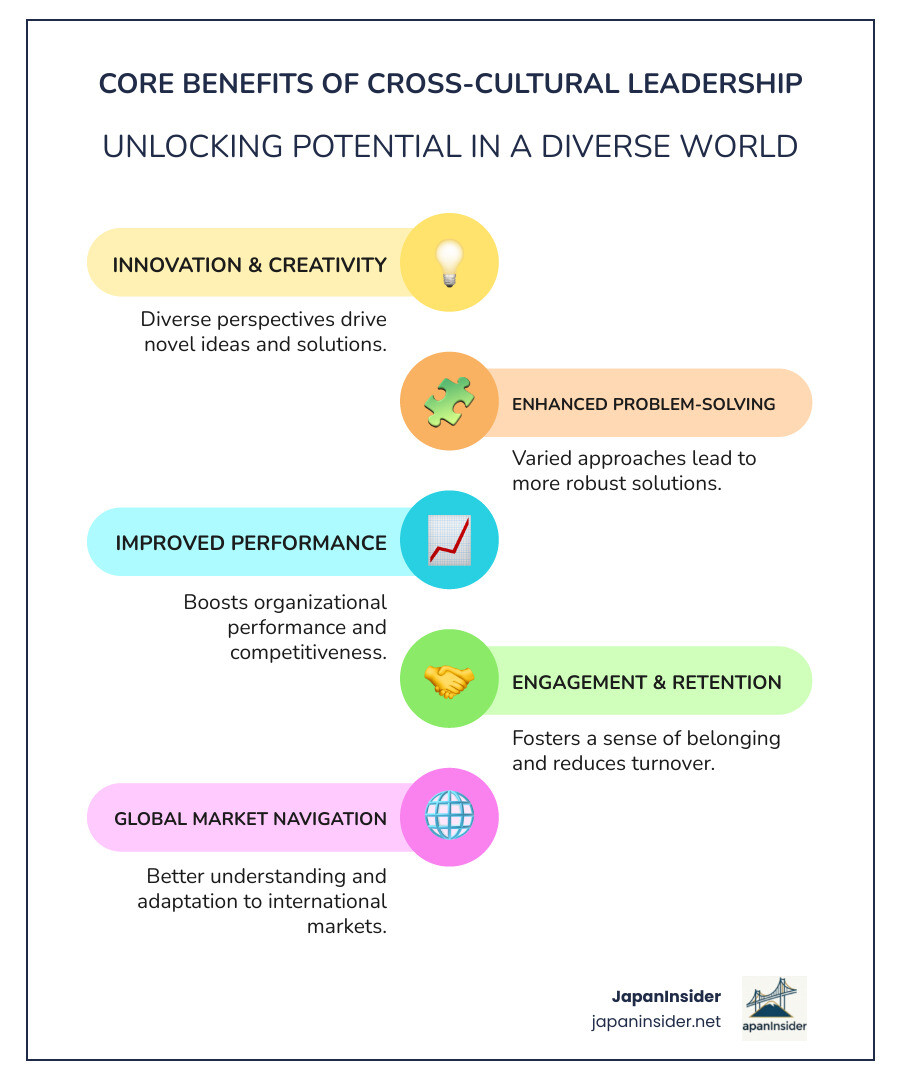
The benefits of getting it right are substantial. Multicultural teams contribute fresh perspectives and innovative ideas that homogeneous groups simply cannot match. When leaders bridge cultural divides, they create something more powerful and dynamic than any single cultural approach. Better problem-solving, improved performance, and improved global competitiveness become achievable outcomes rather than aspirational goals.

However, the path forward is not always clear. A U.S.-based manager accustomed to direct feedback may find their approach misunderstood by team members in Asia, who may expect more indirect input and group discussion. What is effective in one cultural context can undermine trust and effectiveness in another.

I'm Zakari Wato, founder of JapanInsider, and for over fifteen years, I've specialized in guiding Western professionals through the complexities of Japanese business culture and cross-cultural leadership challenges. My work focuses on helping leaders bridge the gap between Western and Japanese business practices to achieve authentic integration and measurable success.

Infographic showing the core benefits of cross-cultural leadership: increased innovation and creativity from diverse perspectives, better problem-solving through varied approaches, improved organizational performance and competitiveness, stronger employee engagement and retention, and enhanced ability to navigate global markets - Cross cultural leadership infographic infographic-line-5-steps-colors

The Core Challenges of Managing Multicultural Teams

Leading multicultural teams is akin to conducting an orchestra where each musician plays a different instrument with a unique rhythm and melody. The potential for a beautiful symphony is immense, but so is the risk of discord. Cross-cultural leadership challenges are among the most significant problems modern leaders face, particularly as remote work and globalization transform today’s workplace. As Gallup research highlights, understanding how different cultural pieces connect is key to success.

a leader looking thoughtful in a virtual meeting with diverse participants - Cross cultural leadership

We often encounter leaders struggling with:

  • Communication barriers: Language is just the tip of the iceberg.
  • Differing leadership expectations: What's respected in one culture might be seen as authoritarian in another.
  • Decision-making styles: Some teams crave consensus, others expect clear directives.
  • Building trust: The foundation of any team, yet built differently across cultures.
  • Managing inclusion: Ensuring every voice is heard and valued, not just the loudest.

Ignoring these challenges can lead to a significant erosion of trust and respect, reduced innovation, increased conflict, and ultimately, a decline in global competitiveness.

One of the most immediate and impactful areas of cultural difference lies in communication and decision-making. We've seen how these dynamics play out, especially when Western and Japanese business cultures meet.

High-context vs. Low-context Communication: In high-context cultures, such as Japan, communication is often indirect and nuanced, relying heavily on nonverbal cues, shared understanding, and implied meanings. People are expected to "read the air" (空気読む - kuuki yomu) and infer messages rather than relying solely on explicit words. In contrast, low-context cultures, such as the United States, prioritize direct, explicit communication, with messages conveyed clearly and unambiguously.

Consider feedback: a U.S.-based manager may be used to quick, direct feedback, while team members in Japan might expect input to come more indirectly, perhaps through a third party or after a long period of observation. This isn't resistance; it's a difference in how respect and information are typically exchanged.

Direct vs. Indirect Feedback: In Japan, maintaining harmony (和 - wa) and saving face (面子 - menboku) are crucial. Direct criticism, especially in public, can cause embarrassment and damage relationships. Feedback is often delivered indirectly, with careful phrasing, or even through a superior who can soften the message. For a Western leader accustomed to "straight talk," this can feel inefficient or unclear. Conversely, Japanese colleagues might perceive direct Western feedback as blunt or even rude.

Hierarchical vs. Consensus-Based Decisions: Decision-making also varies significantly. In many Western cultures, leaders may encourage independent problem-solving and expect team members to voice opinions openly, resulting in a relatively quick decision by the leader. However, in Japan, decision-making often follows a bottom-up, consensus-building process known as nemawashi (根回し), where proposals are informally discussed and agreed upon with all relevant stakeholders before a formal meeting. This ensures group harmony and commitment but can appear slow to those unfamiliar with the process.

The "Effective Meetings Between Japanese and Non-Japanese" article highlights how typical Japanese meetings often proceed organically without a designated leader, which can be confusing for non-Japanese. The highest-ranking person might even sit quietly with eyes closed – a common posture to show they don't intend to dominate the discussion. This is a stark contrast to Western-style meetings where a designated leader is expected to guide discussions and clarify decisions.

Non-verbal Cues and Language Barriers: Beyond spoken words, non-verbal communication (body language, eye contact, silence) carries different weight and meaning across cultures. What is a sign of attentiveness in one culture might be interpreted as disagreement in another. And, of course, language barriers can exacerbate all these issues, making precise communication challenging.

Here's a simplified comparison:

Feature High-Context Cultures (e.g., Japan) Low-Context Cultures (e.g., U.S.)
Communication Style Indirect, implicit, nuanced, relies on shared context, non-verbal cues Direct, explicit, clear, relies on spoken words
Feedback Delivery Indirect, subtle, private, often through intermediaries Direct, open, can be public
Decision-Making Consensus-driven (e.g., nemawashi), slower, focus on harmony and commitment Leader-driven or democratic, faster, focus on efficiency, and individual input
Non-verbal Importance High; silence, gestures, and facial expressions carry significant meaning Moderate; verbal clarity often takes precedence
Emphasis Relationships, group harmony, long-term perspective Task, individual achievement, short-term perspective

The Nuances of Trust, Time, and Work Practices

Beyond communication, how cultures perceive trust, time, and work itself profoundly influences team dynamics.

Task-based Trust vs. Relationship-based Trust: In some cultures, trust is primarily built through consistent performance, reliability, and competence in tasks. Show up on time, deliver quality work, and you earn trust. This is often referred to as task-based trust. In other countries, such as Japan, trust often grows from personal relationships, shared experiences outside of work, and long-term commitment. This relationship-based trust, sometimes referred to by the Chinese term guanxi (though the concept of strong personal connections is vital in Japan as well), means that business may proceed only after significant time has been invested in building rapport and mutual understanding. A Western leader who dives straight into KPIs and contracts without building personal connections might find Japanese partners unresponsive.

Monochronic vs. Polychronic Time Perception: How we view time also shapes our work practices. Monochronic cultures (e.g., Germany, U.S.) tend to view time as linear and sequential. Schedules are strict, appointments are punctual, and tasks are generally completed one at a time. "Time is money" is a common adage. Polychronic cultures (e.g., many parts of Asia, Latin America) view time as more fluid and flexible. Relationships and current events often take precedence over strict schedules, and multiple tasks may be juggled simultaneously. While Japan is often seen as punctual, its approach to decision-making and relationship-building can appear more polychronic, prioritizing thoroughness and harmony over speed. A leader pushing for quick decisions without allowing for nemawashi can cause friction.

Varying Attitudes toward Hierarchy and Authority: In Japan, respect for hierarchy (上下関係 - jōge kankei) and seniority is deeply ingrained. Leaders are expected to provide clear guidance and direction, and questioning authority openly is generally avoided. In contrast, some Western cultures favor flatter hierarchies, encouraging open debate and challenging superiors. A leader in the U.S. might encourage independent problem-solving, while team members from other regions may expect more directive guidance. Misunderstanding these expectations can lead to a Western leader being seen as indecisive or a Japanese leader being perceived as overly authoritarian.

Mastering Cross-Cultural Leadership by Developing Cultural Intelligence (CQ)

Given these complexities, how do we lead effectively? The answer lies in developing our Cultural Intelligence (CQ). Cultural intelligence is the ability to relate to and work effectively with people from different cultural backgrounds. It’s not just about knowing cultural facts; it's about the capability to function effectively across diverse cultural contexts. Leaders with high CQ recognize that behaviors often reflect deeper values, not resistance or lack of effort.

a brain with interconnected cultural symbols - Cross cultural leadership

We believe that CQ encompasses several dimensions:

  • Cognitive CQ: Our knowledge and understanding of different cultures, including their values, norms, and beliefs. This is about learning what to look for.
  • Physical CQ: Our ability to adapt our non-verbal behaviors, such as gestures, facial expressions, and tone of voice, to align with the cultural norms of others. This is about doing it.
  • Motivational CQ: Our interest, drive, and confidence to adapt to new cultural situations and learn from new experiences. This is about wanting to do it.
  • Humility: A willingness to admit what we don't know and to learn from others. As we've seen in Japan, humility is deeply valued and signals respect.
  • Curiosity: An open-minded approach to exploring cultural differences, asking questions, and seeking genuine understanding. The most effective leaders step into complexity with curiosity, humility, and adaptability.
  • Adaptability: The flexibility to adjust our leadership style and approach based on the cultural context, without losing our authenticity.

Strategies to Build Trust and Foster Inclusion

Building trust and fostering inclusion in a multicultural team requires intentional effort and a nuanced approach. It’s about creating an environment where everyone feels valued, respected, and psychologically safe to contribute.

  • Active Listening: This goes beyond just hearing words. It means listening for subtle cues, understanding implied meanings, and confirming understanding, especially in high-context communication cultures like Japan.
  • Creating Psychological Safety: Encourage open dialogue about cultural differences. Make it safe for team members to ask questions, share concerns, and even make mistakes without fear of judgment. In Japan, this might mean creating private settings for feedback or using indirect methods to solicit input.
  • Transparent Decision-Making: Clearly communicate how decisions will be made. If a consensus-based approach like nemawashi is needed, explain the process and timeline. If a leader-driven decision is being made, explain the rationale.
  • Celebrating Contributions Inclusively: Recognize and reward team members in ways that resonate with their cultural values. While individual recognition might be motivating in some cultures, collective recognition for group achievements might be preferred in others.

Here are some actionable steps we recommend for fostering inclusion:

  • Schedule one-on-one check-ins: These provide a safe space for individual team members to share their thoughts and build personal rapport, especially valuable in cultures that prioritize relationship-based trust.
  • Create space for informal team connections: Shared meals, cultural celebrations, or virtual coffee breaks can help bridge cultural gaps and build camaraderie. In Japan, after-work gatherings (nomikai) are often crucial for team bonding.
  • Acknowledge contributions in ways that resonate across cultures: Understand what motivates different team members.
  • Rotate meeting facilitators: This encourages different leadership styles and ensures diverse voices are heard.
  • Use anonymous surveys: This can be a great way to draw out contributions from quieter team members or those who might be hesitant to speak up directly in a hierarchical setting.
  • Directly invite input from quieter team members: "Taro-san, we haven't heard from you yet, what are your thoughts on this?" can be effective if done respectfully and privately.

The Role of Continuous Learning in Effective Cross-Cultural Leadership

Cross-cultural leadership is not a destination; it's a continuous learning journey. The global landscape is constantly evolving, and so are cultural nuances and workplace expectations. Leaders must accept a lifelong learning mindset to stay effective.

  • Reflect on Our Own Cultural Assumptions: We all carry cultural biases. Regularly questioning our assumptions helps us understand why others might behave differently.
  • Learn About Team Members' Backgrounds: Take the time to understand the cultural contexts, values, and experiences of each team member. This can be done through direct conversation, research, or cultural training.
  • Seek Feedback on How Our Leadership Style is Received: Ask for honest feedback on how your leadership approach is perceived across cultures. This requires humility and a genuine desire to adapt.
  • Flex Our Leadership Style: There's no one-size-fits-all approach. Be prepared to adjust your communication, decision-making, and motivational strategies based on the cultural context.
  • Avoid Jargon and Stereotypes: Be mindful of language that might be exclusive or misunderstood. Challenge your own stereotypes and avoid making assumptions about individuals based on their nationality.

For leaders working with Japan, for example, understanding concepts such as honne (true feelings) and tatemae (public facade), the importance of harmony, and the value placed on long-term relationships is critical. This deep cultural understanding enables leaders to turn potential conflict into collaboration and growth.

We at JapanInsider are dedicated to helping Western clients master Japanese business, culture, and daily life. Our expertise in bridging Western and Japanese perspectives is rooted in continuous learning and adapting to the evolving cultural landscape.

To learn more about our approach and services, we invite you to explore our Japan Insider Introduction.

Leadership in Action: Adapting to Global Expectations

Effective cross cultural leadership requires understanding that leadership itself is often perceived differently across the globe. What constitutes a "good leader" in one culture might be ineffective or even offensive in another.osing your organization's core identity. We call this finding the balance between flexibility and fidelity.

  • Establishing a "Third Culture": This isn't about abandoning your own culture or fully adopting another. It's about co-creating a new, shared culture within the team that blends elements from each, focused on mutual understanding and shared goals. This "third culture" becomes the operating system for your multicultural team.
  • Defining Non-Negotiable Core Values: What are the fundamental principles that define your organization? Identify these clearly. While the ways these values are enacted may vary culturally, the values themselves should remain constant. For example, "integrity" might be a core value. In Japan, this might manifest as meticulous attention to detail and an unwavering commitment to honoring commitments at all costs, even if it means personal sacrifice.
  • Empowering Local Leaders: Trusting and empowering local managers, especially in places like Japan, is crucial. They possess invaluable cultural knowledge and can translate organizations
  • Frameworks like Hofstede's Cultural Dimensions and the GLOBE (Global Leadership and Organizational Behavior Effectiveness) Project have provided invaluable insights into these variations.

    Hofstede's Cultural Dimensions identifies six dimensions (Power Distance, Individualism vs. Collectivism, Masculinity vs. Femininity, Uncertainty Avoidance, Long-Term vs. Short-Term Orientation, and Indulgence vs. Restraint) that help us understand cultural differences. For instance, Japan scores high on masculinity and long-term orientation, influencing expectations around work ethic and strategic planning.

    The GLOBE Project further expanded on this, studying leadership in 62 societies and identifying nine cultural dimensions. A key finding was the existence of both universally desirable leadership traits (e.g., being charismatic, team-oriented, and humane) and culturally contingent traits (e.g., being autocratic, self-protective, or status-conscious). This means that while some leadership qualities are appreciated everywhere, others must be adapted to the local context.

    A Global Look at Effective Cross-Cultural Leadership

    No single leadership style works everywhere. Effective cross cultural leadership involves being aware of, in sync with, and actively involved in defining, modeling, and coaching your culture and values, while also adapting your approach to fit the context.

    • Paternalistic Leadership: Prevalent in some non-Western business organizations, such as mainland China, this style combines strong discipline and authority with fatherly benevolence and moral integrity. It's about a leader acting as a parent figure, providing guidance and protection in exchange for loyalty.
    • Changeal Leadership: This style, focused on inspiring a shared vision, mentoring, and building trust, has shown varying effectiveness across cultures. While generally positive, its specific impact on performance and trust can differ. For example, research found that changeal leadership predicted performance and trust in Australia, but only trust in China.
    • Transactional Leadership: This style emphasizes clear exchanges between leader and follower (rewards for performance, corrective action for deviations). Like changeal leadership, its effectiveness can be culturally moderated.
    • Charismatic/Value-Based Leadership: Universally admired traits often include being visionary, inspirational, and self-sacrificing.
    • Team-Oriented Leadership: Emphasizing collaboration, common purpose, and group cohesion, this style is highly effective in collectivistic cultures like Japan.

    The Project GLOBE research provides a deeper understanding of these nuances, highlighting that leaders need intercultural competence: the ability to understand and respect other cultural norms while balancing the team’s overall goals.

    Balancing Cultural Adaptation with Core Organizational Values

    One of the trickiest aspects of cross-cultural leadership is knowing how far to adapt without lnal values into culturally appropriate actions.
  • Creating Clear Communication Channels for Value Alignment: Regularly discuss what your core values mean in different cultural contexts. How does "innovation" look in Aomori versus Tokyo, or in a Western context? These conversations help ensure everyone is working towards the same goals with a shared understanding.
  • Maintaining Authenticity: While adaptation is key, leaders must also remain authentic to themselves and their organization. Insincere attempts at cultural mimicry are often transparent and can undermine trust. The most effective leaders are those who step into complexity with curiosity, humility, and adaptability, not mimicry.

The Organizational Impact of Global Leadership

The payoff for effective cross cultural leadership is significant. It's not just about avoiding pitfalls; it's about open uping immense potential. When leaders successfully steer cultural differences, the result is more powerful and dynamic than any single approach on its own.

  • Increased Innovation: Multicultural teams contribute fresh perspectives and innovative ideas. Different ways of thinking, problem-solving, and approaching tasks lead to more creative solutions.
  • Better Problem-Solving: Diverse teams bring a broader range of experiences and cognitive styles to the table, leading to better problem solving. This diversity of thought allows for more robust analysis and comprehensive solutions.
  • Improved Performance: When teams are inclusive and culturally intelligent, they perform better. Studies show that diverse teams often outperform homogeneous ones, leading to improved performance.
  • Global Competitiveness: In today's interconnected marketplace, organizations with strong cross cultural leadership are better positioned to expand into new markets, understand global customer needs, and steer international business complexities.
  • Employee Engagement and Retention: A workplace that values diversity and fosters inclusion leads to higher employee engagement and retention. When employees feel understood and respected, regardless of their cultural background, they are more likely to thrive.

Training and Developing Your Next Generation of Global Leaders

How do organizations cultivate these essential cross-cultural leadership skills? It requires a strategic and multifaceted approach to training and development.

  • Cross-Cultural Training Programs: These programs are vital for building cognitive CQ. They can cover cultural norms, communication styles, business etiquette, and historical context for specific regions, such as Japan. For Western leaders coming to Japan, understanding concepts like honne and tatemae, nemawashi, and the importance of group harmony is crucial.
  • Experiential Learning: Nothing beats hands-on experience. This includes short-term assignments, participation in international projects, or rotations in multicultural teams. Learning by doing, reflecting on experiences, and receiving feedback are powerful drivers of CQ development.
  • Expatriate Assignments: While challenging, expatriate assignments offer unparalleled opportunities for leaders to immerse themselves in a new culture and develop deep cross cultural leadership skills. Support for these assignments, including pre-departure training and ongoing mentorship, is critical to their success.
  • Mentorship Programs: Pairing emerging leaders with experienced global leaders or cultural mentors can provide invaluable guidance and insights into navigating complex cultural situations.
  • Creating a Culturally Intelligent Organization: This goes beyond individual training. It involves embedding inclusive leadership practices, ensuring inclusion is not a one-time effort but a daily reality. It means adapting HR policies, communication strategies, and organizational culture to support diversity.

At JapanInsider, we offer bespoke training and development programs designed to equip leaders with the cross-cultural leadership skills needed to thrive in Japan. Our programs focus on practical application, drawing on real-world scenarios and our deep understanding of both Western and Japanese business contexts.

Stay informed about our latest insights and offerings by subscribing to our Japan Insider Newsletter.

Frequently Asked Questions about Cross-Cultural Leadership

What are the first steps to improve my cross-cultural leadership skills?

Start with self-awareness by reflecting on your own cultural biases. Then, focus on developing curiosity and active listening skills. Learn about the specific cultures of your team members through research and respectful conversation. For example, if you're working with a Japanese team, take the time to understand their communication preferences and decision-making processes.

How do I handle a conflict that stems from a cultural misunderstanding?

Address the conflict privately and calmly. Approach the conversation with curiosity, not blame. Ask open-ended questions to understand each person's perspective and the cultural values that may be influencing their actions. Work together to find a mutually respectful solution. In some cultures, direct confrontation is avoided, so you may need to facilitate an indirect resolution.

Can a single leadership style work globally?

No, research consistently shows that a one-size-fits-all leadership approach is ineffective. While some traits like integrity and vision are universally appreciated, effective leaders must adapt their communication, motivation, and decision-making styles to fit the local cultural context. What inspires a team in Aomori might not resonate with a team in Tokyo, let alone a team in another country.

Conclusion

In today's globalized world, cross cultural leadership is no longer a niche skill for expatriates; it's a fundamental requirement for any leader steering a team, whether local or remote, that includes individuals from diverse backgrounds. We've explored the primary challenges from navigating nuanced communication and decision-making styles to building trust across varying cultural expectations of time and authority. We've also highlighted the critical role of Cultural Intelligence (CQ) as the cornerstone for effective cross cultural leadership, emphasizing the importance of humility, curiosity, and adaptability.

The journey of cross-cultural leadership is one of continuous learning. It demands that we reflect on our own biases, actively seek to understand others, and flex our leadership styles to fit the context, rather than imposing a single way of doing things. The benefits are clear: increased innovation, better problem-solving, improved performance, and improved global competitiveness.

At JapanInsider, we believe that differences are where the spark of innovation lives. We equip individuals and organizations with the skills to turn complexity into clarity and differences into strengths. Our expertise in bridging Western and Japanese perspectives allows us to offer authentic, culturally sensitive solutions that empower leaders to build stronger, more dynamic teams.

Don't let cultural differences become barriers. Let them be your greatest asset.

Explore our cross-cultural consulting services today and transform cross cultural leadership challenges into your greatest advantage.

Western Directness: The Cultural Disguise of Efficiency

Watto, Z. (2026a). Western Directness : The Cultural Disguise of Efficiency. Retrieved March 31, 2026, from https://aomorijapaninsider.blogs...