Why Mastering Business Cards Japanese Etiquette Can Make or Break Your Success in Japan

Business cards japanese etiquette is far more than learning a polite gesture—it's understanding a ritual that shapes your entire professional reputation in Japan. In a culture where nearly 8 in 10 professionals still rely on printed cards, and about 7 in 10 report that business card exchanges led to positive business outcomes, getting this right matters.
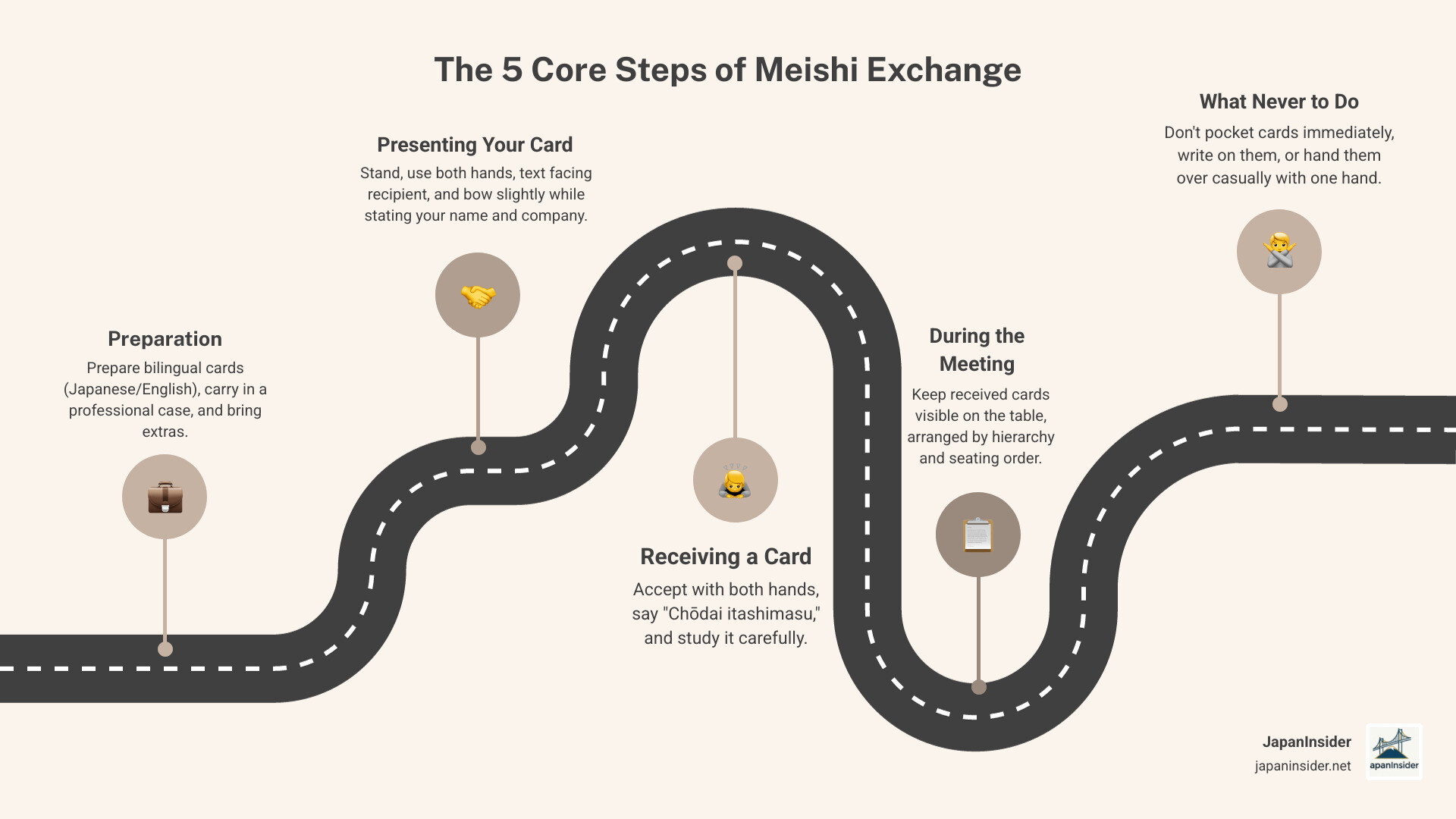
Quick Guide to Japanese Business Card Exchange:
- Before the Meeting - Prepare bilingual cards (Japanese/English), carry them in a professional case, bring more than you think you'll need
- Presenting Your Card - Stand, hold with both hands, face the text toward the recipient, bow slightly while stating your name and company
- Receiving a Card - Accept with both hands, say "Chōdai itashimasu," study it carefully before placing it on the table
- During the Meeting - Keep received cards visible on the table, arranged by hierarchy and seating order
- What Never to Do - Don't pocket cards immediately, write on them, or hand them over casually with one hand
The stakes are high. As one source puts it bluntly: "If you don’t have a business card in Japan, it means you are of no consequence or you do not exist." Your meishi (名刺) represents your professional identity—your "face" in Japanese business culture. How you handle this exchange tells Japanese counterparts whether you respect their customs, understand hierarchy, and deserve their trust.
I'm Zakari Wato, founder of JapanInsider, and over my fifteen years working in cross-cultural business communication in Japan, I've seen countless Western professionals either build strong relationships or inadvertently damage them based on their understanding of business cards japanese etiquette. This guide will ensure you're in the first category.
Why Your Meishi is More Than Just a Card
In Japan, a business card, or meishi, is far more than just a piece of paper with contact information. It's an extension of yourself, a tangible representation of your professional "face" (顔, kao), and a powerful symbol of trust. The way you present and receive a meishi can set the tone for an entire business relationship. It embodies the concept of ichi-go ichi-e (一期一会), meaning "one chance, one meeting"—emphasizing the unique and unrepeatable nature of each encounter. This makes the initial exchange of cards a moment of profound significance.
To illustrate the difference in cultural approaches, let's look at a quick comparison between Japanese and Western business card etiquette:
| Feature | Japanese Business Card Culture | Western Business Card Culture |
|---|---|---|
| Significance | Ritualistic, represents identity/status, builds trust, extension of self | Functional, contact information, networking tool |
| Exchange | Formal, two hands, bow, specific order (hierarchy), at the beginning of a meeting | Casual, one hand often, less emphasis on order, can be anytime during interaction |
| Handling | Treated with utmost respect, studied carefully, placed on table by rank, never written on | Often quickly pocketed, may be written on, less ceremonial |
| Condition | Must be pristine, high-quality paper, professional design | Less stringent, minor wear acceptable |
| Purpose | Formal introduction, establishes relationship, acknowledges hierarchy | Shares contact info, facilitates follow-up |
| Consequence of Faux Pas | Can damage reputation, imply disrespect, hinder relationship building | Minor, rarely impacts business relationship significantly |
The Deep Significance of Meishi in Japanese Culture
The meishi plays a pivotal role in Japanese business culture because it provides access to an individual's identity within a group-oriented society. Unlike many Western cultures that emphasize individual achievement, Japan often places the group (company, department) first. Your meishi immediately clarifies your position within that group. It's not just your card; it's a representation of your company, its values, and its standing.
The tradition of using business cards in Japan dates back centuries, possibly influenced by 15th-century China or even earlier. However, their widespread adoption and the ritualized exchange we see today became deeply ingrained in the Meiji period, influenced by the introduction of Western business practices. This makes the meishi exchange a formal introduction, a crucial first step in any professional interaction. To learn more about the broader context, explore our guide on More on Japanese work culture.
How a Card's Condition Reflects on You
Imagine handing over a crumpled, dog-eared card to a new contact. In the West, it might elicit a shrug. In Japan? It's a significant faux pas. The condition of your meishi is a direct reflection of your professionalism and, by extension, your company's image. A pristine, high-quality card signals attention to detail, respect for the interaction, and seriousness about business. A worn or dirty card, conversely, can be seen as disrespectful and suggest a lack of care.
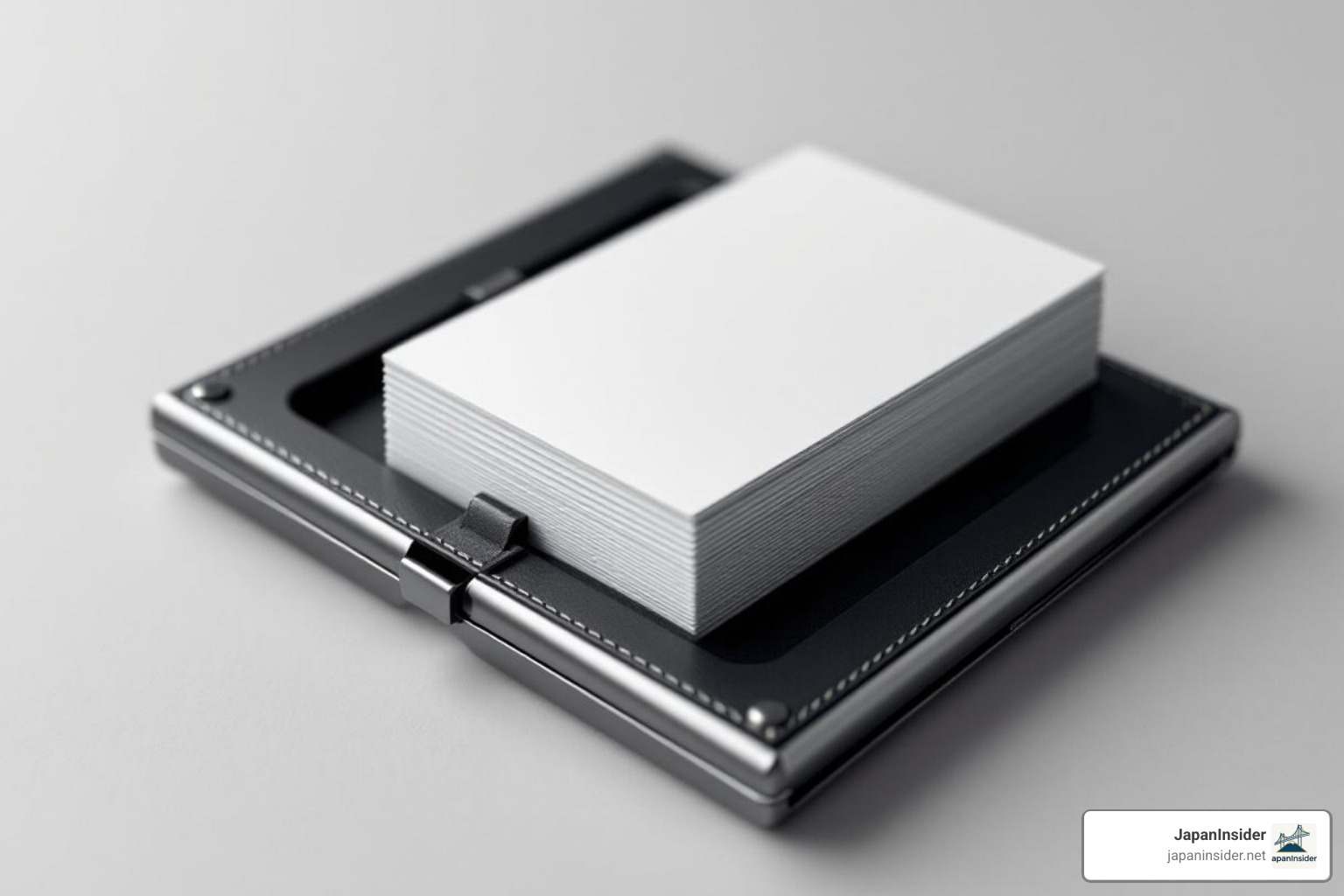
This is why we always recommend using a dedicated card case (meishi-ire) to protect your cards. Keeping them clean, crisp, and easily accessible shows preparedness and respect. It's a small detail that makes a big impression.
Preparing for a Flawless Exchange
Before you even step into a meeting, preparation is key. Having the right meishi and being mentally ready for the exchange will ensure you steer this crucial ritual with confidence and grace.
Designing the Perfect Bilingual Meishi
For any foreigner doing business in Japan, a bilingual meishi is not just a good idea—it's essential. It demonstrates your effort, respect for the local culture, and makes it easier for your Japanese counterparts to read and understand your information.
- Standard Size: The standard size for Japanese business cards is 91mm x 55mm, which is slightly larger than the typical U.S. card (89mm x 51mm). Adhering to this standard size shows you've done your homework.
- Layout: Most bilingual cards have English on one side and Japanese on the other. Ensure the Japanese side is easily readable and correctly translated.
- Essential Information: Include your name, title, company name, address, phone number, email, and website. For foreign names, using Katakana (the Japanese script for foreign words) on the Japanese side is highly recommended. For example, "John Smith" would become "ジョン・スミス" (Jon Sumisu). This aids pronunciation and recognition.
- Fonts: Opt for clean, professional, and legible fonts on both sides. Avoid overly decorative or hard-to-read styles.
- QR Codes: While physical cards remain dominant, QR codes are becoming more common. Including one that links to your LinkedIn profile or company website can be a modern touch, bridging the gap between traditional and digital.
Printing Your Cards in Japan
Getting your cards printed in Japan can be a smart move, ensuring they meet local standards and often offering quick turnaround times.
Here are some tips for printing your business cards japanese etiquette in Japan:
- Bilingual Support: Many Japanese printing services are accustomed to producing bilingual cards. Look for those that explicitly offer English support for ordering.
- Reputable Printers: Companies like Mojo Print, K-1 Print, Printpac, and Monkey Print are well-known options in Japan that offer various printing services. While JapanInsider is based in Aomori City and Tokyo, these services are generally accessible nationwide or online.
- Typical Costs: A basic run of 100 cards in Japan starts around ¥1,000–¥2,500 (approx. $7–$17 USD), making them quite affordable.
- Turnaround Times: Standard delivery is usually 2–4 business days domestically. Some services even offer express printing within hours if you're in a pinch.
- Minimum Quantities: While some printers have minimum order quantities, others offer small-batch printing, sometimes as few as 30–50 cards.
- What to Prepare: Have your design file ready, preferably in a print-ready format like PDF. If you need translation, ensure it's accurate and ideally checked by a native speaker to avoid embarrassing errors.
The Art of the Exchange: A Step-by-Step Guide to Business Cards Japanese Etiquette
The meishi koukan (名刺交換), or business card exchange ritual, is a carefully choreographed dance of respect and hierarchy. Paying attention to these non-verbal cues and key phrases will demonstrate your understanding and respect for Japanese culture.

The Giving Process
When it's your turn to present your meishi, remember these steps:
- Stand Up: Always stand up when exchanging cards, even if you are already seated. This shows respect.
- Hold Card with Two Hands: Present your card with both hands, holding it by the top two corners to avoid obscuring any information.
- Orient Text Towards Recipient: Ensure the Japanese side of your card is facing up and oriented so the recipient can read it without turning it.
- State Your Name and Company: As you present the card, offer a polite introduction. A common phrase is: "Hajimemashite, [Your Company Name] no [Your Name] to moushimasu. Yoroshiku onegaishimasu." (Nice to meet you, I am [Your Name] from [Your Company Name]. Please treat me well/I look forward to working with you).
- Bow Slightly: Accompany your introduction with a slight bow. The depth of the bow can vary with the other person's status, but a respectful nod is generally sufficient for foreigners.
The Receiving Process
Receiving a meishi is just as important as giving one:
- Receive with Two Hands: Accept the other person's card with both hands, holding it by the bottom two corners. This prevents you from touching their name or company logo, which is considered disrespectful.
- Say "Choudai itashimasu": As you receive the card, say "Choudai itashimasu" (I humbly receive this) or "Arigatō gozaimasu" (Thank you).
- Read the Card Carefully: Take a moment to look at the card, read their name and title. This shows you are paying attention and value the person. If you're unsure how to pronounce their name, it's polite to ask for clarification.
- Acknowledge Their Name and Title: You might repeat their name or title to confirm, showing engagement. Address them by their surname followed by "-san" (e.g., Tanaka-san).
- Never Immediately Pocket the Card: This is a major faux pas. It implies you don't value the person or their identity.
Navigating Hierarchy and Multiple Exchanges
Hierarchy is a fundamental aspect of Japanese business culture, and it profoundly influences the meishi exchange.
- Exchanging with the Most Senior Person First: When meeting a group, always begin the exchange with the highest-ranking individual present. Then proceed down the line in order of seniority.
- Visitor or Junior Person Initiates: Generally, the visiting party or the person of lower rank should offer their card first. If ranks appear equal, the visitor typically initiates the exchange.
- Holding Your Card Lower: As a subtle sign of respect, try to hold your card slightly lower than that of a more senior person when exchanging.
- Arranging Multiple Cards on the Table: If you're in a meeting with several Japanese counterparts, arrange their meishi neatly on the table in front of you. Place them in the same order as the individuals are seated, with the highest-ranking person's card often placed centrally or on top of your card case. This allows you to remember names and roles throughout the discussion and shows you are attentive.
After the Exchange: Common Mistakes and Modern Trends
The meishi ritual doesn't end when the cards are exchanged. How you handle them afterward, and your awareness of evolving trends, further demonstrates your cultural sensitivity.
Common Mistakes in Business Cards Japanese Etiquette and How to Avoid Them
Even with the best intentions, foreigners can sometimes make missteps. Here's a list of what not to do when it comes to business cards japanese etiquette, and why:
- Writing on a Card in Front of the Person: This is considered extremely rude, akin to defacing their "face." If you must make a note, ask for permission or wait until they've left the room.
- Fidgeting with the Card: Tapping, bending, or playing with a meishi shows disrespect for the person it represents.
- Storing it in a Back Pocket: Placing a received card in your back pocket is often interpreted as "sitting on someone's face or reputation," a grave insult. Use a dedicated card case or an inside jacket pocket.
- Running Out of Cards: Being unprepared is seen as unprofessional. Always bring more cards than you think you'll need.
- Forgetting to Bring Cards: This is a significant embarrassment and can severely damage your credibility. It's like refusing to shake hands in a Western business meeting.
- One-Handed Exchange: Handing over or receiving a card with one hand appears casual and dismissive.
- Ignoring or Placing the Card Away Immediately: Failing to look at the card or quickly tucking it away suggests you don't care about the person or their information.
- Initiating Business Talk Right Away: The meishi exchange is a formal introduction; it's not the time to jump straight into negotiations. Allow a moment for the ritual to conclude.
- Disregarding Hierarchical Order: Exchanging with a junior person before a senior one can cause awkwardness and imply you don't understand or respect their social structure.
Are Digital Business Cards Accepted in Japan?
While digital solutions are gaining traction globally, traditional physical meishi still hold a dominant position in Japan. Nearly 8 in 10 Japanese professionals still use printed business cards, highlighting their enduring importance.
- Physical Cards Still Dominant: For formal in-person meetings, a physical meishi is almost always expected. It carries the weight of tradition and respect that digital alternatives currently lack.
- Digital Cards for Online Meetings: In the age of remote work, digital business cards are increasingly used for online meetings or when physical exchange isn't possible. However, they typically don't carry the same ceremonial weight.
- QR Codes as a Hybrid Solution: Many modern Japanese meishi include QR codes that link to digital profiles. This offers a convenient way to share additional information while retaining the traditional physical exchange.
- Lack of Personal Touch with Digital: The act of physically exchanging cards, with its bows and two-handed gestures, is a crucial part of building personal rapport. Digital exchanges, while efficient, often miss this nuanced personal connection.
- General Advice: If you rely on a digital card, always ask if it's acceptable to share it. Be prepared to offer alternative contact methods if a digital exchange isn't preferred. For any important first impression in Japan, a physical, bilingual meishi is still your best bet.
Frequently Asked Questions about Japanese Business Card Etiquette
We often get questions from Western clients about specific scenarios. Here are some common ones:
What should I do if I forget or run out of business cards?
This is a tricky situation, but recovery is possible. If you realize you've forgotten or run out of cards, apologize sincerely and immediately. You can say, "Meishi wo kirashite orimashite, moushiwake gozaimasen" (I have run out of business cards, I am truly sorry). Then, offer to send your contact details via email immediately after the meeting, or even offer to mail a physical card. The key is to acknowledge the oversight and demonstrate your intent to provide the information respectfully.
Who should give their business card first in a meeting?
The general rule is that the visiting party or the person of lower rank should offer their card first. If you are visiting a Japanese company, you, as the guest, would typically initiate the exchange after initial greetings. If ranks are perceived as equal, the visitor still usually takes the lead. This gesture shows respect for the host and acknowledges their position.
Is it ever okay to write on a business card I've received?
Generally, no, it is considered rude to write on someone's meishi in front of them. The card is treated as an extension of the person, and defacing it is seen as disrespectful. If you absolutely must make a note (e.g., to remember a detail about the person or meeting), it's best to ask for permission first, or discreetly make the note on a separate pad or in your own card case after the person has left the room. Never do it while they are present and observing you.
Conclusion
Mastering business cards japanese etiquette is more than just memorizing rules; it's about embracing a mindset of respect, meticulous preparation, and keen attention to detail. The meishi exchange is your critical first step in building lasting trust and fostering strong, respectful business relationships in Japan. It's a testament to the fact that in Japan, every interaction, no matter how small, has significance.
At JapanInsider, we specialize in bridging Western and Japanese perspectives, providing authentic, culturally sensitive solutions for your business ventures. We understand the nuances that can make all the difference.
Get expert help navigating Japanese business culture and learn more about JapanInsider Introduction. We're here to help you succeed, whether you're in Aomori City, Tokyo, or anywhere else you're engaging with Japanese business.

.png)
.jpeg)
.png)
.png)
No comments:
Post a Comment