Why Language is Your Key to Business in Japan

Japan business language is the cornerstone of professional success in one of the world's most sophisticated business environments. Understanding and using appropriate Japanese business communication isn't just about vocabulary—it's about demonstrating respect, building trust, and navigating the complex social hierarchies that define Japanese corporate culture.
Quick Answer: Core Elements of Japan Business Language
- Keigo (敬語): A three-tiered honorific system (polite, respectful, humble language)
- Business Etiquette: Formal greetings, bowing, and meishi (business card) exchange
- Hierarchy Awareness: Language changes based on rank and relationship
- Uchi-Soto Dynamics: Different speech for in-group vs. out-group members
- Indirect Communication: Reading between the lines and maintaining harmony (wa)
The numbers tell a stark story. Japan ranks 53rd out of 100 countries in English proficiency, placing it in the "low proficiency" band. With 99.2% of the population speaking Japanese as their first language, the ability to communicate in business Japanese isn't optional—it's essential. Many Western professionals underestimate this barrier, assuming English will suffice in Tokyo's international business districts. They quickly find that even in global companies, critical decisions, relationship-building, and day-to-day operations happen in Japanese.
The challenge extends beyond vocabulary. Japanese business language operates on fundamentally different principles than Western communication styles. Where Western business culture values directness and individual expression, Japanese business culture prioritizes harmony, hierarchy, and collective decision-making. The language reflects these values through keigo, a complex system that requires speakers to adjust their speech based on social position, context, and relationship.
Consider this: when a Japanese colleague says "That might be difficult" (chotto muzukashii desu ne), they're likely expressing a polite but firm "no." When they respond with "hai" during a presentation, they're acknowledging they're listening—not necessarily agreeing. These nuances, embedded in the language itself, can make or break business relationships.
The good news? Foreigners who invest in learning Japan business language gain immediate credibility. Your Japanese counterparts don't expect perfection, but they deeply appreciate the effort. Even basic proficiency in business phrases and etiquette signals respect for their culture and serious commitment to the relationship. In a business environment where trust is earned slowly through consistent behavior, this cultural fluency accelerates relationship-building in ways that technical expertise alone cannot.
I'm Zakari Wato, founder of JapanInsider, and I've spent over fifteen years helping Western professionals steer the complexities of Japan business language and cross-cultural communication in Japanese corporate settings. My expertise in bridging Western and Japanese business practices comes from living and working in Japan, where I've seen how mastering business Japanese transforms professional outcomes.
The Unspoken Rules: Mastering Japanese Business Etiquette Before You Speak
Before we even dive into the linguistic intricacies of Japan business language, it's crucial to understand the unspoken rules that govern Japanese business interactions. These cultural pillars form the foundation upon which all communication is built. Without this understanding, even perfectly spoken Japanese can fall flat.
Japanese companies are characterized by a strong sense of hierarchy, with clear lines of authority and decision-making flowing from the top. Seniority, often linked to age and length of service, plays a significant role in promotion and position. This hierarchical structure deeply influences how people interact and communicate, emphasizing deference to superiors and respect for elders.
Punctuality, for instance, is paramount. Arriving 5-10 minutes early for any meeting or appointment isn't just polite; it's expected. Being late, even by a minute, can be seen as a sign of disrespect. Another core value is group harmony, or wa. This concept discourages strong opinions, direct confrontation, or anything that might disrupt the collective peace. Decisions are often made by consensus, which can make the process seem slow to Westerners, but ensures everyone is on board.
The distinction between in-group (uchi) and out-group (soto) is also a fundamental concept. Your "uchi" might be your company or immediate team, while "soto" refers to clients, external partners, or other companies. This dynamic dictates the level of formality and the specific keigo you'll use. When speaking about your uchi to an soto member, you'll humble your own group, for example.
A crucial principle in Japanese work culture is Hō-Ren-Sō, which stands for Hōkoku (Report), Renraku (Inform), and Sōdan (Consult). This emphasizes continuous communication, reporting progress, sharing information, and consulting with colleagues and superiors to ensure smooth operations and efficient teamwork.
Finally, we encounter indirect communication and humility. The phrase "Hear one, understand ten" (ichi ieba ju wo shiru) perfectly encapsulates the Japanese communication style, which relies heavily on shared context and implicit understanding. This means that direct statements are often avoided, and a "no" might be expressed as "that might be difficult." Humility is also highly valued, especially in job interviews, where modesty about achievements is preferred over boasting. By understanding and respecting these cultural nuances, foreign professionals can gain a significant competitive edge, strengthening relationships and demonstrating genuine commitment.
Greetings and Bowing: More Than Just a Nod
In Japan, a simple greeting often involves a bow, and it's far more nuanced than a casual nod. The depth of the bow conveys different levels of respect and formality.

There are three main types of bows you'll encounter in business:
- Eshaku (会釈): This is a light, informal bow, typically around 15 degrees from the waist. It's used for casual greetings with colleagues, acknowledging someone's presence, or a quick thank you. Think of it as a polite nod.
- Keirei (敬礼): A more respectful bow, about 30 degrees. This is standard for greeting clients, expressing gratitude, or offering a sincere apology. It's a common bow in most formal business situations.
- Saikeirei (最敬礼): The deepest bow, reaching 45 degrees or more, often with hands flat on your thighs. This is reserved for the highest levels of respect, such as greeting a VIP, showing profound gratitude, or offering a very deep apology.
When to bow? We bow when greeting and saying goodbye to business associates. However, you generally won't see people bowing in busy shops or large hotels.
Verbal greetings are also essential. "Ohayou gozaimasu" (Good morning) is used until around noon, while "Konnichiwa" (Hello/Good afternoon) is for later in the day. "Arigatou gozaimasu" (Thank you) is a universal expression of gratitude. A particularly versatile and untranslatable phrase is "Otsukaresama desu/deshita" (お疲れ様です/でした). Literally meaning "You must be tired (with respect)," it can be used as a greeting, an acknowledgment of someone's hard work ("well done"), or a farewell ("goodbye") among colleagues.
The Business Card (Meishi) Exchange Ritual
The exchange of business cards, or meishi (名刺), is a fundamental ritual in Japanese business, far more formalized than in many Western cultures. It's not just about swapping contact information; it's about showing respect for the individual and their company.

We treat business cards as an extension of one's "face," and therefore, handling them with utmost care is crucial. Here’s how we do it:
- Presenting with two hands: Offer your card with both hands, facing the recipient so they can read it immediately. Your position should be slightly lower than theirs if they are senior.
- Receiving with two hands: Accept their card with both hands, bowing slightly. It's polite to receive their card with your thumbs on the top corners and fingers supporting the bottom.
- Reading the card: Don't just glance! Take a careful look at their card, noting their name, title, and company. This shows you value them. You might even repeat their name aloud.
- Placement on the table: During a meeting, place the received cards on the table in front of you, arranged in the order of seating, with the most senior person's card closest to you. This helps you remember names and positions.
- After the meeting: Do not put the card in your back pocket or write on it! Store it respectfully in a business card holder, ideally in your breast pocket, never a pants pocket.
Having one side of your business card in Japanese and the other in English is highly recommended. This helps your Japanese counterparts easily understand your position and correctly pronounce your name, which they take pride in doing. Failing to offer a business card at the first meeting is considered poor etiquette, signaling a lack of interest.
The Core of Japan Business Language: A Guide to Keigo (敬語)
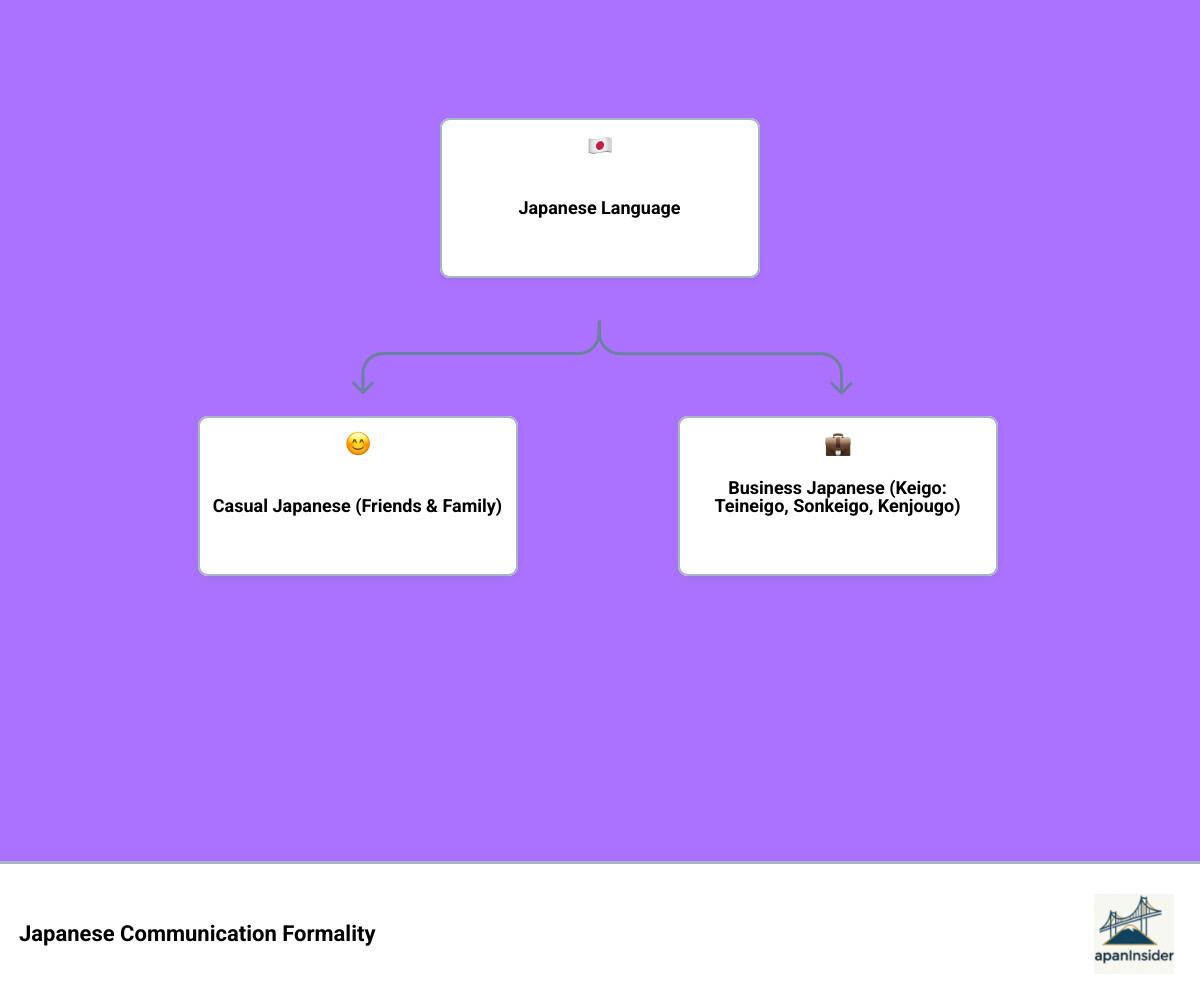
At the heart of Japan business language lies Keigo (敬語), the system of honorific speech. It’s not merely about being polite; it's a sophisticated linguistic framework that reflects the intricate social hierarchy and cultural values of respect, humility, and harmony. While everyday Japanese (Hyojungo, or Standard Japanese) is what you'd learn in basic language classes and use with friends, business Japanese requires a mastery of Keigo.
Hyojungo (標準語) is the standard form of Japanese, taught in schools and used in official settings and national media. It ensures mutual understanding across different regions, with a neutral pronunciation modeled after the Tokyo dialect. However, in professional contexts, we lift our language to Keigo.
The distinction between casual and business Japanese is profound. Business Japanese eschews slang and informal expressions, opting for specific polite phrases and a structured system of politeness. The formality isn't just a nicety; it's crucial for showing respect, maintaining social harmony, and demonstrating professionalism. The consequences of not using Keigo properly can be severe. It can lead to misunderstandings, breed skepticism, and erode trust, potentially signaling incompetence or a lack of seriousness in a business relationship. For us at JapanInsider, understanding and applying Keigo is a cornerstone of effective cross-cultural communication.
Teineigo (丁寧語): The Foundation of Politeness
Teineigo (丁寧語), or polite language, is the most basic and frequently used form of Keigo. Think of it as the default setting for polite communication in Japanese. It's neutral in its respect, simply indicating a polite stance towards the listener without explicitly elevating or humbling anyone.
We use Teineigo in most everyday interactions where politeness is expected, such as with strangers, acquaintances, or in initial workplace interactions. The most recognizable feature of Teineigo is the use of the "-masu" verb ending and the "-desu" sentence ending. For example, "I eat" becomes "tabemasu" (食べます), and "It is good" becomes "ii desu" (いいです).
For foreign professionals, mastering Teineigo is the first crucial step. It provides a solid foundation for all other forms of Keigo and allows for respectful communication in a wide range of business scenarios without the complexities of Sonkeigo or Kenjougo. It's the language you'll use when you're not sure which other form to apply, ensuring you're always polite.
Sonkeigo (尊敬語) and Kenjougo (謙譲語): Elevating Others, Humbling Yourself
Now, let's step into the more intricate fields of Sonkeigo (尊敬語) and Kenjougo (謙譲語). These forms are where the "in-group" (uchi) and "out-group" (soto) dynamic truly comes into play, as they are used to explicitly lift the status of the listener or a third party, or humbly lower the speaker's own status or that of their in-group.
- Sonkeigo (Respectful Language): We use Sonkeigo to show respect to someone of higher status, such as a superior, a client, or an elder. It's about "raising" the person you are talking about. This often involves using special verbs, honorific prefixes, or passive constructions. For example, instead of "you go" (iku), you might say "irassharu" (いらっしゃる).
- Kenjougo (Humble Language): We use Kenjougo to humbly refer to our own actions or the actions of someone within our uchi (in-group) when speaking to an soto (out-group) member or a superior. It's about "lowering" yourself or your group to show respect to the other party. For instance, instead of "I go" (iku), you might say "mairu" (まいる) or "ukagau" (うかがう).
This distinction is crucial for navigating Japanese business interactions. When addressing a client, we use Sonkeigo for their actions and Kenjougo for our own. When talking about our boss to a client, we use Kenjougo for our boss's actions, but when talking to our boss, we use Sonkeigo for their actions. It's a delicate balance that demonstrates a deep understanding of social hierarchy.
Here's a table illustrating some common verbs in their plain, Sonkeigo, and Kenjougo forms:
| Plain Form | Sonkeigo (Respectful) | Kenjougo (Humble) | English Equivalent |
|---|---|---|---|
| する (suru) | なさる (nasaru) | いたす (itasu) | To do |
| いる (iru) | いらっしゃる (irassharu) | おる (oru) | To be, to exist |
| 行く (iku) | いらっしゃる (irassharu) | 参る (mairu) | To go |
| 来る (kuru) | いらっしゃる (irassharu) | 参る (mairu) | To come |
| 食べる (taberu) | 召し上がる (meshiagaru) | いただく (itadaku) | To eat |
| 言う (iu) | おっしゃる (ossharu) | 申す (mōsu) | To say |
| 見る (miru) | ご覧になる (goran ni naru) | 拝見する (haiken suru) | To see |
Understanding Honorifics and Prefixes
Beyond the verb conjugations, honorifics (suffixes) and prefixes are vital components of Keigo that we use daily in Japanese business.
- -san (さん): This is the most common and versatile honorific, equivalent to Mr., Ms., Mrs., or Miss. We attach it to surnames, and sometimes first names, for general politeness when addressing or referring to almost anyone—colleagues, clients, or service staff. It's a safe default.
- -sama (様): A more respectful version of -san, used for customers, clients, or individuals of very high status. We typically see this in formal letters, emails, and customer service. For example, "お客様" (o-kyaku-sama) means "esteemed customer." We avoid using -sama internally for our own colleagues when speaking to external parties.
- -kun (君): Generally used for addressing younger males, subordinates, or male friends. It's less formal than -san but still carries a degree of respect. We might use it for a junior male colleague or a male student.
- -chan (ちゃん): An affectionate suffix primarily for children, close female friends, or pets. We absolutely avoid this in a business context, as it's highly informal and would be considered inappropriate.
- -senpai (先輩): Used for senior colleagues or mentors, regardless of gender. It acknowledges their experience and seniority. For example, "Tanaka-senpai."
- -sensei (先生): Reserved for teachers, doctors, lawyers, artists, or other respected professionals. It signifies respect for their expertise.
A key rule for the uchi-soto dynamic: when speaking to an outsider (soto) about someone from your own group (uchi), we drop the honorific. For example, you would refer to your colleague Tanaka-san as "Tanaka" to a client, humbling your own group member in front of the outsider.
We also use polite prefixes, most notably 御 (o-/go-). These prefixes are added to nouns or verbs to make them more polite or respectful. Generally, "go-" precedes Sino-Japanese words (words derived from Chinese), while "o-" precedes native Japanese words. For example, "o-cha" (tea) or "go-renraku" (contact/report). Using these correctly is a subtle but powerful way to demonstrate linguistic sophistication and respect.
Putting It All to Work: Essential Phrases for Business Scenarios
For foreign professionals looking to thrive in Japan, mastering Japan business language is a game-changer. The challenges of job seeking in Japan, for instance, are often compounded by a lack of language proficiency. While your technical skills might be top-notch, without the ability to communicate effectively in Japanese, you're at a significant disadvantage. Language proficiency helps overcome these barriers, showcasing respect for the local culture and giving you a competitive edge.
It's also interesting to note that gender differences can manifest in Japanese speech, particularly in the use of politeness and honorifics. Historically, women might have used more honorifics in informal settings, but in business, professionalism dictates a more standardized approach.
A common mistake we often see foreigners make is misapplying Keigo, such as using a respectful term for themselves (which should be humble) or a humble term for a client (which should be respectful). Another frequent misstep is misjudging the uchi-soto dynamic, for example, by attaching "-san" to a colleague's name when speaking to a customer. We'll explore how to avoid these pitfalls by learning practical phrases.
Nailing the Job Interview
Job interviews in Japan are a unique beast. Unlike Western interviews where self-promotion is often encouraged, Japanese interviews emphasize humility and modesty. Your ability to demonstrate respect and cultural awareness through language is paramount.
Here are some essential Japanese business phrases for interviews:
- Self-introduction: 「[Your Name] と申します。」 ([Your Name] to mōshimasu.) - A humble way to say "My name is [Your Name]."
- Opening greeting: 「どうぞよろしくお願いいたします。」 (Dōzo yoroshiku onegai itashimasu.) - A polite and humble way to say "Please treat me well," often used at the beginning of a new relationship.
- Expressing strengths/weaknesses: 「私の強みはです。」 (*Watashi no tsuyomi wa _ desu.*) - "My strength is ." (For weakness, use 「弱みはです。」 (*yowami wa __ desu.*)). Be modest and focus on areas for growth rather than outright flaws.
- Discussing experience: 「私はの経験があります。」 (*Watashi wa _ no keiken ga arimasu.*) - "I have experience in __."
- Asking for clarification: 「もう一度おっしゃっていただけますか。」 (Mō ichido osshatte itadakemasu ka?) - "Could you please say that again?" (A respectful way to ask for repetition).
- Asking questions: 「いくつか質問してもいいですか。」 (Ikutsu ka shitsumon shite mo ii desu ka?) - "May I ask some questions?"
- Expressing gratitude at the end: 「面接のお時間をいただき、どうもありがとうございました。」 (Mensetsu no o-jikan o itadaki, dōmo arigatō gozaimashita.) - "Thank you very much for your time for the interview." (Always remember a polite bow, or Keirei, before leaving).
Communicating in the Workplace: Meetings, Calls, and Emails
Effective communication in the Japanese workplace extends beyond formal interviews to daily interactions, meetings, phone calls, and emails.
Meetings: Japanese business meetings have their own rhythm. Seating arrangements are determined by hierarchy, with the most senior person at the head of the table and guests typically seated furthest from the entry (kamiza). We always start with polite small talk to build rapport before diving into business. Presentations should be clear, concise, and visual, often simplified for non-native English speakers. The most vocal person isn't necessarily the decision-maker; observe carefully. If Japanese participants need to switch to their native language for a moment, they should ask permission, keep it short (ideally under three minutes), and summarize the discussion afterward for everyone. A crucial step after any meeting is to send a follow-up email, expressing thanks, noting key discussion points, and clarifying action items.
Phone Calls: Phone etiquette is highly formalized. We aim to answer within three rings, identify ourselves and our company clearly.
- Answering: 「はい、もしもし、[Your Company Name] でございます。」 (Hai, moshimoshi, [Your Company Name] de gozaimasu.) - "This is [Your Company Name]."
- General greeting: 「いつもお世話になっております。」 (Itsumo o-sewa ni natte orimasu.) - "Thank you for your continued support." (A versatile greeting for established contacts).
- Asking for someone: 「[Person's Name] さんはいらっしゃいますか。」 ([Person's Name]-san wa irasshaimasu ka?) - "Is Mr./Ms. [Person's Name] there?" (Respectful).
- Asking to wait: 「少々お待ちくださいませ。」 (Shōshō o-machi kudasai mase.) - "Please wait a moment." (Polite).
- If someone is out: 「[Person's Name] はただいま外出しております。」 ([Person's Name] wa tadaima gaishutsu shite orimasu.) - "[Person's Name] is currently out." (Humble).
- Offering a callback: 「[Person's Name] へ折り返しお電話をさしあげるよう申し伝えます。」 ([Person's Name] e orikaeshi o-denwa o sashiageru yō mōshitsutaemasu.) - "I will tell [Person's Name] to call you back." (Humble).
Emails: Email communication in Japan demands precision. A survey showed that "Wording" is the number one focus when people send emails, and "Typo" ranked second in importance. We always use formal greetings and closings, clear subject lines, and a structured format. Respond within 24 hours. Avoid using read receipts, as they can be considered rude.
- Starting an email: 「いつも大変お世話になっております。」 (Itsumo taihen osewa ni natte orimasu.) - "Thank you for your continued support." (A standard, highly polite opening).
- Referring to attachments: 「添付資料をご確認くださいませ。」 (Tenpu shiryō o go-kakunin kudasai mase.) - "Please check the attached documents."
- Offering assistance: 「何かご不明点、ご質問がございましたら、ご遠慮なくお知らせください。」 (Nani ka go-fumeiten, go-shitsumon ga gozaimashitara, go-enryo naku o-shirase kudasai.) - "If you have any questions, please do not hesitate to ask."
- Closing an email: 「今後ともどうぞよろしくお願いいたします。」 (Kongo tomo dōzo yoroshiku onegai itashimasu.) - "We look forward to your continued support." (A common polite closing).
When interacting with coworkers, especially initially, we start with Keigo. As relationships develop, the language might become slightly less formal, but maintaining respect, particularly with superiors (senpai), is always key. The Hō-Ren-Sō principle (Report-Inform-Consult) is paramount in all internal communication.
A Practical Vocabulary for the Japan Business Language
Having a solid vocabulary is crucial for navigating any business environment. Here are some frequently used Japan business language words relevant to company structure, meetings, and roles:
Company Structure & Roles:
- 会社 (Kaisha): Company
- 社長 (Shachō): Company President / CEO
- 部長 (Buchō): Department Manager
- 課長 (Kachō): Section Manager
- 先輩 (Senpai): Senior colleague / Mentor
- 後輩 (Kōhai): Junior colleague
- 弊社 (Heisha): Our company (humble, used when speaking to outsiders)
- 御社 (Onsha): Your company (respectful, used when speaking to outsiders)
- 貴社 (Kisha): Your company (respectful, used in formal writing to outsiders)
Meeting-Related Words:
- 会議 (Kaigi): Meeting
- 議題 (Gidai): Agenda
- 資料 (Shiryou): Documents / Materials
- 提案 (Teian): Proposal
- 打ち合わせ (Uchiawase): Business meeting / Discussion (often less formal than kaigi)
- 報告 (Hōkoku): Report
- 連絡 (Renraku): Information / Contact
- 相談 (Sōdan): Consultation
- 合意 (Goui): Agreement
- 条件 (Jōken): Conditions / Terms
- 価格 (Kakaku): Price
By familiarizing yourself with these phrases and vocabulary, you can confidently steer business meetings, negotiations, and correspondence, demonstrating respect for Japanese culture and enhancing professional interactions.
Frequently Asked Questions about Japan Business Language
What is the biggest difference between casual and business Japanese?
The primary difference is the use of Keigo (敬語), or honorific speech. Business Japanese requires a complex system of polite, respectful, and humble language to steer social hierarchy, which is absent in casual, informal Japanese used with friends and family.
Can I succeed in business in Japan without speaking Japanese?
While possible in some international sectors, not speaking Japanese is a significant handicap. English proficiency is low, and business culture is deeply intertwined with the language. Learning even basic Japan business language shows respect and opens doors that would otherwise remain closed.
What is the most common mistake foreigners make?
A common mistake is applying Japanese honorifics incorrectly, such as using a respectful term for oneself or a humble term for a client. Another is misjudging the 'uchi-soto' (in-group/out-group) dynamic, for example, by attaching '-san' to a colleague's name when speaking to a customer.
Conclusion: Your Journey to Fluency Starts Here
As we've explored, mastering Japan business language is a journey that goes far beyond mere vocabulary. It's an intricate dance of etiquette, hierarchy, and cultural values that defines professional success in Japan. From the subtle art of bowing and the ritual of meishi exchange to the complex layers of Keigo, every interaction is an opportunity to build trust and demonstrate respect.
The key takeaways are clear: accept the nuances of Keigo (Teineigo, Sonkeigo, and Kenjougo), understand the uchi-soto dynamics, prioritize harmony, and always approach communication with humility. Your Japanese counterparts deeply appreciate the effort you put into learning their language and culture, even if your Japanese isn't perfect. This effort acts as a powerful bridge, fostering stronger relationships and opening doors that might otherwise remain closed.
At JapanInsider, we understand the challenges and rewards of this journey. We're here in Aomori City and Tokyo, ready to help you steer the complexities of Japanese business and culture. For personalized guidance on mastering Japanese business communication, explore our Services. Let us help you transform your professional interactions and truly connect in Japan.

.png)
.jpeg)
.png)
.png)
No comments:
Post a Comment