2026-01-17

Don't Fumble Your Meishi: A How-To Guide for Japanese Business Card Etiquette

Why Mastering Business Cards Japanese Etiquette Can Make or Break Your Success in Japan

business card exchange in Japanese office - business cards japanese etiquette

Business cards japanese etiquette is far more than learning a polite gesture—it's understanding a ritual that shapes your entire professional reputation in Japan. In a culture where nearly 8 in 10 professionals still rely on printed cards, and about 7 in 10 report that business card exchanges led to positive business outcomes, getting this right matters.

Quick Guide to Japanese Business Card Exchange:

  1. Before the Meeting - Prepare bilingual cards (Japanese/English), carry them in a professional case, bring more than you think you'll need
  2. Presenting Your Card - Stand, hold with both hands, face the text toward the recipient, bow slightly while stating your name and company
  3. Receiving a Card - Accept with both hands, say "Chōdai itashimasu," study it carefully before placing it on the table
  4. During the Meeting - Keep received cards visible on the table, arranged by hierarchy and seating order
  5. What Never to Do - Don't pocket cards immediately, write on them, or hand them over casually with one hand

The stakes are high. As one source puts it bluntly: "If you don’t have a business card in Japan, it means you are of no consequence or you do not exist." Your meishi (名刺) represents your professional identity—your "face" in Japanese business culture. How you handle this exchange tells Japanese counterparts whether you respect their customs, understand hierarchy, and deserve their trust.

I'm Zakari Wato, founder of JapanInsider, and over my fifteen years working in cross-cultural business communication in Japan, I've seen countless Western professionals either build strong relationships or inadvertently damage them based on their understanding of business cards japanese etiquette. This guide will ensure you're in the first category.
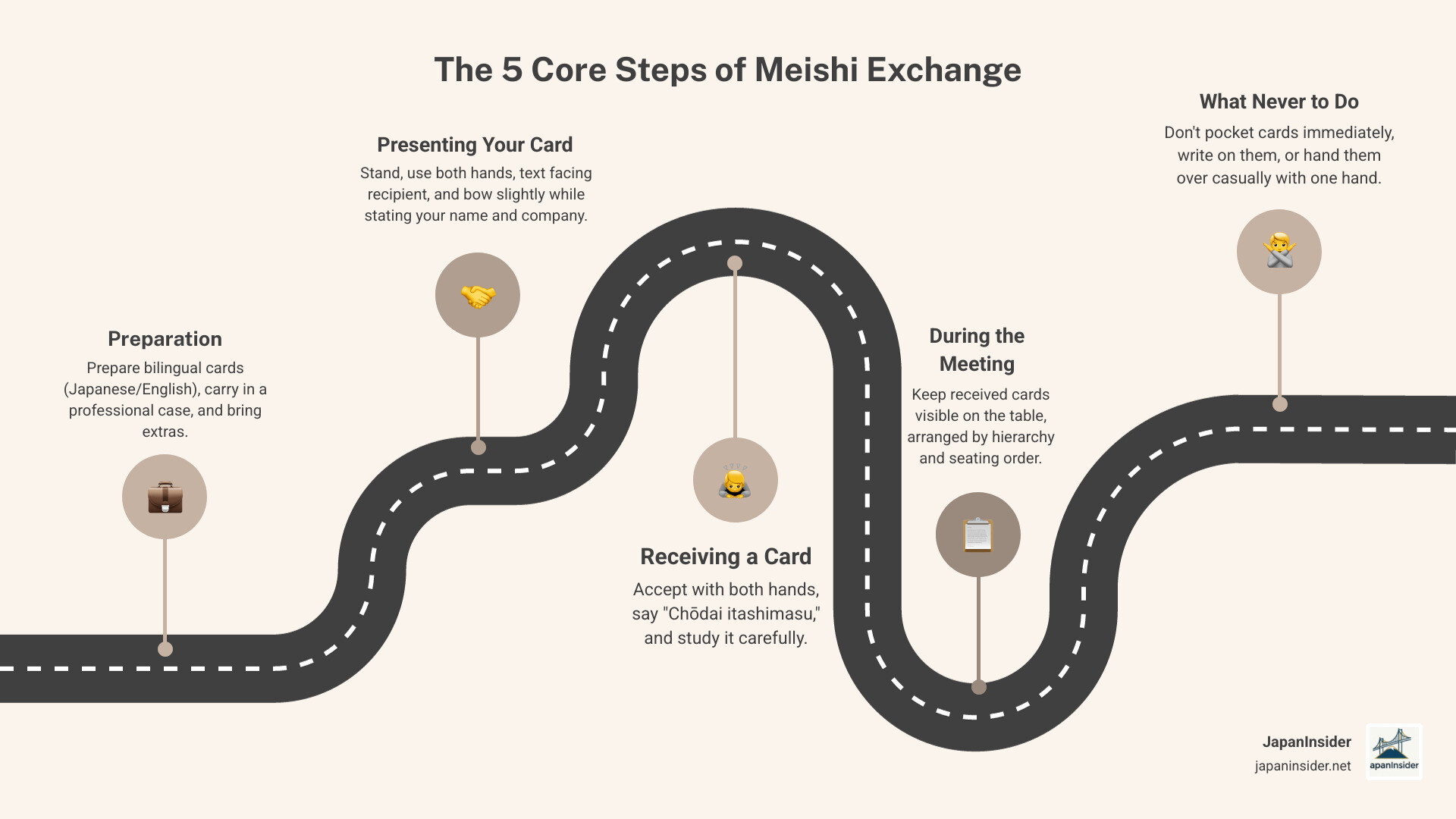
infographic showing the five core steps of meishi exchange: 1. Stand and prepare your card case 2. Present with both hands, text facing recipient, with a bow 3. Receive with both hands and say thank you 4. Study the card carefully 5. Place on table during meeting, never pocket immediately - business cards japanese etiquette infographic roadmap-5-steps

Why Your Meishi is More Than Just a Card

In Japan, a business card, or meishi, is far more than just a piece of paper with contact information. It's an extension of yourself, a tangible representation of your professional "face" (顔, kao), and a powerful symbol of trust. The way you present and receive a meishi can set the tone for an entire business relationship. It embodies the concept of ichi-go ichi-e (一期一会), meaning "one chance, one meeting"—emphasizing the unique and unrepeatable nature of each encounter. This makes the initial exchange of cards a moment of profound significance.

To illustrate the difference in cultural approaches, let's look at a quick comparison between Japanese and Western business card etiquette:

Feature Japanese Business Card Culture Western Business Card Culture
Significance Ritualistic, represents identity/status, builds trust, extension of self Functional, contact information, networking tool
Exchange Formal, two hands, bow, specific order (hierarchy), at the beginning of a meeting Casual, one hand often, less emphasis on order, can be anytime during interaction
Handling Treated with utmost respect, studied carefully, placed on table by rank, never written on Often quickly pocketed, may be written on, less ceremonial
Condition Must be pristine, high-quality paper, professional design Less stringent, minor wear acceptable
Purpose Formal introduction, establishes relationship, acknowledges hierarchy Shares contact info, facilitates follow-up
Consequence of Faux Pas Can damage reputation, imply disrespect, hinder relationship building Minor, rarely impacts business relationship significantly

The Deep Significance of Meishi in Japanese Culture

The meishi plays a pivotal role in Japanese business culture because it provides access to an individual's identity within a group-oriented society. Unlike many Western cultures that emphasize individual achievement, Japan often places the group (company, department) first. Your meishi immediately clarifies your position within that group. It's not just your card; it's a representation of your company, its values, and its standing.

The tradition of using business cards in Japan dates back centuries, possibly influenced by 15th-century China or even earlier. However, their widespread adoption and the ritualized exchange we see today became deeply ingrained in the Meiji period, influenced by the introduction of Western business practices. This makes the meishi exchange a formal introduction, a crucial first step in any professional interaction. To learn more about the broader context, explore our guide on More on Japanese work culture.

How a Card's Condition Reflects on You

Imagine handing over a crumpled, dog-eared card to a new contact. In the West, it might elicit a shrug. In Japan? It's a significant faux pas. The condition of your meishi is a direct reflection of your professionalism and, by extension, your company's image. A pristine, high-quality card signals attention to detail, respect for the interaction, and seriousness about business. A worn or dirty card, conversely, can be seen as disrespectful and suggest a lack of care.

This is why we always recommend using a dedicated card case (meishi-ire) to protect your cards. Keeping them clean, crisp, and easily accessible shows preparedness and respect. It's a small detail that makes a big impression.
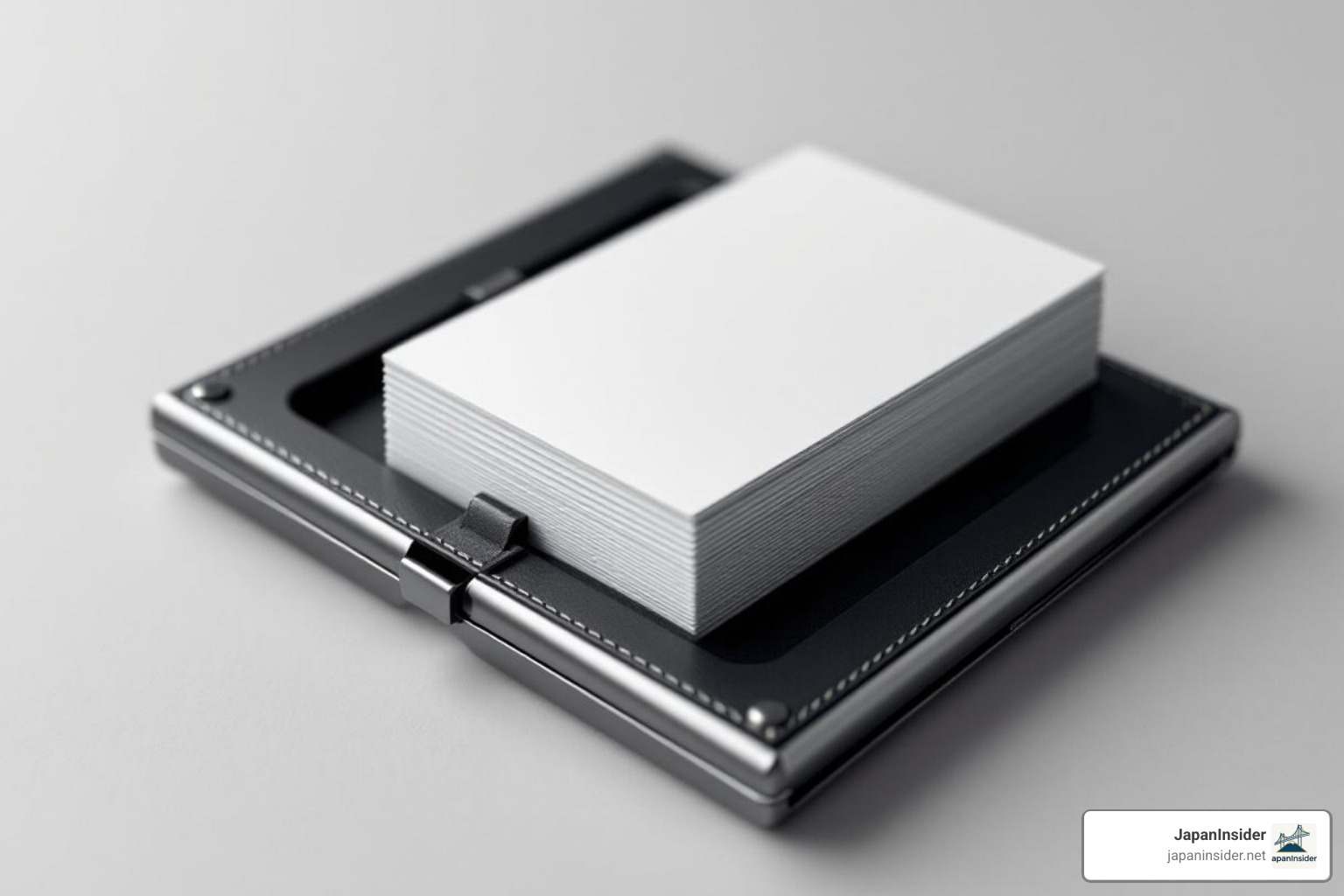
a clean, professional business card case with several business cards inside - business cards japanese etiquette

Preparing for a Flawless Exchange

Before you even step into a meeting, preparation is key. Having the right meishi and being mentally ready for the exchange will ensure you steer this crucial ritual with confidence and grace.

Designing the Perfect Bilingual Meishi

For any foreigner doing business in Japan, a bilingual meishi is not just a good idea—it's essential. It demonstrates your effort, respect for the local culture, and makes it easier for your Japanese counterparts to read and understand your information.

  • Standard Size: The standard size for Japanese business cards is 91mm x 55mm, which is slightly larger than the typical U.S. card (89mm x 51mm). Adhering to this standard size shows you've done your homework.
  • Layout: Most bilingual cards have English on one side and Japanese on the other. Ensure the Japanese side is easily readable and correctly translated.
  • Essential Information: Include your name, title, company name, address, phone number, email, and website. For foreign names, using Katakana (the Japanese script for foreign words) on the Japanese side is highly recommended. For example, "John Smith" would become "ジョン・スミス" (Jon Sumisu). This aids pronunciation and recognition.
  • Fonts: Opt for clean, professional, and legible fonts on both sides. Avoid overly decorative or hard-to-read styles.
  • QR Codes: While physical cards remain dominant, QR codes are becoming more common. Including one that links to your LinkedIn profile or company website can be a modern touch, bridging the gap between traditional and digital.

Printing Your Cards in Japan

Getting your cards printed in Japan can be a smart move, ensuring they meet local standards and often offering quick turnaround times.

Here are some tips for printing your business cards japanese etiquette in Japan:

  • Bilingual Support: Many Japanese printing services are accustomed to producing bilingual cards. Look for those that explicitly offer English support for ordering.
  • Reputable Printers: Companies like Mojo Print, K-1 Print, Printpac, and Monkey Print are well-known options in Japan that offer various printing services. While JapanInsider is based in Aomori City and Tokyo, these services are generally accessible nationwide or online.
  • Typical Costs: A basic run of 100 cards in Japan starts around ¥1,000–¥2,500 (approx. $7–$17 USD), making them quite affordable.
  • Turnaround Times: Standard delivery is usually 2–4 business days domestically. Some services even offer express printing within hours if you're in a pinch.
  • Minimum Quantities: While some printers have minimum order quantities, others offer small-batch printing, sometimes as few as 30–50 cards.
  • What to Prepare: Have your design file ready, preferably in a print-ready format like PDF. If you need translation, ensure it's accurate and ideally checked by a native speaker to avoid embarrassing errors.

The Art of the Exchange: A Step-by-Step Guide to Business Cards Japanese Etiquette

The meishi koukan (名刺交換), or business card exchange ritual, is a carefully choreographed dance of respect and hierarchy. Paying attention to these non-verbal cues and key phrases will demonstrate your understanding and respect for Japanese culture.

two hands presenting a business card - business cards japanese etiquette

The Giving Process

When it's your turn to present your meishi, remember these steps:

  1. Stand Up: Always stand up when exchanging cards, even if you are already seated. This shows respect.
  2. Hold Card with Two Hands: Present your card with both hands, holding it by the top two corners to avoid obscuring any information.
  3. Orient Text Towards Recipient: Ensure the Japanese side of your card is facing up and oriented so the recipient can read it without turning it.
  4. State Your Name and Company: As you present the card, offer a polite introduction. A common phrase is: "Hajimemashite, [Your Company Name] no [Your Name] to moushimasu. Yoroshiku onegaishimasu." (Nice to meet you, I am [Your Name] from [Your Company Name]. Please treat me well/I look forward to working with you).
  5. Bow Slightly: Accompany your introduction with a slight bow. The depth of the bow can vary with the other person's status, but a respectful nod is generally sufficient for foreigners.

The Receiving Process

Receiving a meishi is just as important as giving one:

  1. Receive with Two Hands: Accept the other person's card with both hands, holding it by the bottom two corners. This prevents you from touching their name or company logo, which is considered disrespectful.
  2. Say "Choudai itashimasu": As you receive the card, say "Choudai itashimasu" (I humbly receive this) or "Arigatō gozaimasu" (Thank you).
  3. Read the Card Carefully: Take a moment to look at the card, read their name and title. This shows you are paying attention and value the person. If you're unsure how to pronounce their name, it's polite to ask for clarification.
  4. Acknowledge Their Name and Title: You might repeat their name or title to confirm, showing engagement. Address them by their surname followed by "-san" (e.g., Tanaka-san).
  5. Never Immediately Pocket the Card: This is a major faux pas. It implies you don't value the person or their identity.

Hierarchy is a fundamental aspect of Japanese business culture, and it profoundly influences the meishi exchange.

  • Exchanging with the Most Senior Person First: When meeting a group, always begin the exchange with the highest-ranking individual present. Then proceed down the line in order of seniority.
  • Visitor or Junior Person Initiates: Generally, the visiting party or the person of lower rank should offer their card first. If ranks appear equal, the visitor typically initiates the exchange.
  • Holding Your Card Lower: As a subtle sign of respect, try to hold your card slightly lower than that of a more senior person when exchanging.
  • Arranging Multiple Cards on the Table: If you're in a meeting with several Japanese counterparts, arrange their meishi neatly on the table in front of you. Place them in the same order as the individuals are seated, with the highest-ranking person's card often placed centrally or on top of your card case. This allows you to remember names and roles throughout the discussion and shows you are attentive.

The meishi ritual doesn't end when the cards are exchanged. How you handle them afterward, and your awareness of evolving trends, further demonstrates your cultural sensitivity.

Common Mistakes in Business Cards Japanese Etiquette and How to Avoid Them

Even with the best intentions, foreigners can sometimes make missteps. Here's a list of what not to do when it comes to business cards japanese etiquette, and why:

  • Writing on a Card in Front of the Person: This is considered extremely rude, akin to defacing their "face." If you must make a note, ask for permission or wait until they've left the room.
  • Fidgeting with the Card: Tapping, bending, or playing with a meishi shows disrespect for the person it represents.
  • Storing it in a Back Pocket: Placing a received card in your back pocket is often interpreted as "sitting on someone's face or reputation," a grave insult. Use a dedicated card case or an inside jacket pocket.
  • Running Out of Cards: Being unprepared is seen as unprofessional. Always bring more cards than you think you'll need.
  • Forgetting to Bring Cards: This is a significant embarrassment and can severely damage your credibility. It's like refusing to shake hands in a Western business meeting.
  • One-Handed Exchange: Handing over or receiving a card with one hand appears casual and dismissive.
  • Ignoring or Placing the Card Away Immediately: Failing to look at the card or quickly tucking it away suggests you don't care about the person or their information.
  • Initiating Business Talk Right Away: The meishi exchange is a formal introduction; it's not the time to jump straight into negotiations. Allow a moment for the ritual to conclude.
  • Disregarding Hierarchical Order: Exchanging with a junior person before a senior one can cause awkwardness and imply you don't understand or respect their social structure.

Are Digital Business Cards Accepted in Japan?

While digital solutions are gaining traction globally, traditional physical meishi still hold a dominant position in Japan. Nearly 8 in 10 Japanese professionals still use printed business cards, highlighting their enduring importance.

  • Physical Cards Still Dominant: For formal in-person meetings, a physical meishi is almost always expected. It carries the weight of tradition and respect that digital alternatives currently lack.
  • Digital Cards for Online Meetings: In the age of remote work, digital business cards are increasingly used for online meetings or when physical exchange isn't possible. However, they typically don't carry the same ceremonial weight.
  • QR Codes as a Hybrid Solution: Many modern Japanese meishi include QR codes that link to digital profiles. This offers a convenient way to share additional information while retaining the traditional physical exchange.
  • Lack of Personal Touch with Digital: The act of physically exchanging cards, with its bows and two-handed gestures, is a crucial part of building personal rapport. Digital exchanges, while efficient, often miss this nuanced personal connection.
  • General Advice: If you rely on a digital card, always ask if it's acceptable to share it. Be prepared to offer alternative contact methods if a digital exchange isn't preferred. For any important first impression in Japan, a physical, bilingual meishi is still your best bet.

Frequently Asked Questions about Japanese Business Card Etiquette

We often get questions from Western clients about specific scenarios. Here are some common ones:

What should I do if I forget or run out of business cards?

This is a tricky situation, but recovery is possible. If you realize you've forgotten or run out of cards, apologize sincerely and immediately. You can say, "Meishi wo kirashite orimashite, moushiwake gozaimasen" (I have run out of business cards, I am truly sorry). Then, offer to send your contact details via email immediately after the meeting, or even offer to mail a physical card. The key is to acknowledge the oversight and demonstrate your intent to provide the information respectfully.

Who should give their business card first in a meeting?

The general rule is that the visiting party or the person of lower rank should offer their card first. If you are visiting a Japanese company, you, as the guest, would typically initiate the exchange after initial greetings. If ranks are perceived as equal, the visitor still usually takes the lead. This gesture shows respect for the host and acknowledges their position.

Is it ever okay to write on a business card I've received?

Generally, no, it is considered rude to write on someone's meishi in front of them. The card is treated as an extension of the person, and defacing it is seen as disrespectful. If you absolutely must make a note (e.g., to remember a detail about the person or meeting), it's best to ask for permission first, or discreetly make the note on a separate pad or in your own card case after the person has left the room. Never do it while they are present and observing you.

Conclusion

Mastering business cards japanese etiquette is more than just memorizing rules; it's about embracing a mindset of respect, meticulous preparation, and keen attention to detail. The meishi exchange is your critical first step in building lasting trust and fostering strong, respectful business relationships in Japan. It's a testament to the fact that in Japan, every interaction, no matter how small, has significance.

At JapanInsider, we specialize in bridging Western and Japanese perspectives, providing authentic, culturally sensitive solutions for your business ventures. We understand the nuances that can make all the difference.

Get expert help navigating Japanese business culture and learn more about JapanInsider Introduction. We're here to help you succeed, whether you're in Aomori City, Tokyo, or anywhere else you're engaging with Japanese business.


Hajimemashite! Navigating Japanese Business Introductions and Beyond

Why Language is Your Key to Business in Japan

Japanese business professionals in modern office - Japan business language

Japan business language is the cornerstone of professional success in one of the world's most sophisticated business environments. Understanding and using appropriate Japanese business communication isn't just about vocabulary—it's about demonstrating respect, building trust, and navigating the complex social hierarchies that define Japanese corporate culture.

Quick Answer: Core Elements of Japan Business Language

  • Keigo (敬語): A three-tiered honorific system (polite, respectful, humble language)
  • Business Etiquette: Formal greetings, bowing, and meishi (business card) exchange
  • Hierarchy Awareness: Language changes based on rank and relationship
  • Uchi-Soto Dynamics: Different speech for in-group vs. out-group members
  • Indirect Communication: Reading between the lines and maintaining harmony (wa)

The numbers tell a stark story. Japan ranks 53rd out of 100 countries in English proficiency, placing it in the "low proficiency" band. With 99.2% of the population speaking Japanese as their first language, the ability to communicate in business Japanese isn't optional—it's essential. Many Western professionals underestimate this barrier, assuming English will suffice in Tokyo's international business districts. They quickly find that even in global companies, critical decisions, relationship-building, and day-to-day operations happen in Japanese.

The challenge extends beyond vocabulary. Japanese business language operates on fundamentally different principles than Western communication styles. Where Western business culture values directness and individual expression, Japanese business culture prioritizes harmony, hierarchy, and collective decision-making. The language reflects these values through keigo, a complex system that requires speakers to adjust their speech based on social position, context, and relationship.

Consider this: when a Japanese colleague says "That might be difficult" (chotto muzukashii desu ne), they're likely expressing a polite but firm "no." When they respond with "hai" during a presentation, they're acknowledging they're listening—not necessarily agreeing. These nuances, embedded in the language itself, can make or break business relationships.

The good news? Foreigners who invest in learning Japan business language gain immediate credibility. Your Japanese counterparts don't expect perfection, but they deeply appreciate the effort. Even basic proficiency in business phrases and etiquette signals respect for their culture and serious commitment to the relationship. In a business environment where trust is earned slowly through consistent behavior, this cultural fluency accelerates relationship-building in ways that technical expertise alone cannot.

I'm Zakari Wato, founder of JapanInsider, and I've spent over fifteen years helping Western professionals steer the complexities of Japan business language and cross-cultural communication in Japanese corporate settings. My expertise in bridging Western and Japanese business practices comes from living and working in Japan, where I've seen how mastering business Japanese transforms professional outcomes.

Infographic showing the hierarchy of Japanese business language from casual Japanese to Hyojungo (standard) to the three types of Keigo: Teineigo (polite language with desu/masu), Sonkeigo (respectful language elevating others), and Kenjougo (humble language lowering yourself), with examples of when each is used in business contexts - Japan business language infographic hierarchy

The Unspoken Rules: Mastering Japanese Business Etiquette Before You Speak

Before we even dive into the linguistic intricacies of Japan business language, it's crucial to understand the unspoken rules that govern Japanese business interactions. These cultural pillars form the foundation upon which all communication is built. Without this understanding, even perfectly spoken Japanese can fall flat.

Japanese companies are characterized by a strong sense of hierarchy, with clear lines of authority and decision-making flowing from the top. Seniority, often linked to age and length of service, plays a significant role in promotion and position. This hierarchical structure deeply influences how people interact and communicate, emphasizing deference to superiors and respect for elders.

Punctuality, for instance, is paramount. Arriving 5-10 minutes early for any meeting or appointment isn't just polite; it's expected. Being late, even by a minute, can be seen as a sign of disrespect. Another core value is group harmony, or wa. This concept discourages strong opinions, direct confrontation, or anything that might disrupt the collective peace. Decisions are often made by consensus, which can make the process seem slow to Westerners, but ensures everyone is on board.

The distinction between in-group (uchi) and out-group (soto) is also a fundamental concept. Your "uchi" might be your company or immediate team, while "soto" refers to clients, external partners, or other companies. This dynamic dictates the level of formality and the specific keigo you'll use. When speaking about your uchi to an soto member, you'll humble your own group, for example.

A crucial principle in Japanese work culture is Hō-Ren-Sō, which stands for Hōkoku (Report), Renraku (Inform), and Sōdan (Consult). This emphasizes continuous communication, reporting progress, sharing information, and consulting with colleagues and superiors to ensure smooth operations and efficient teamwork.

Finally, we encounter indirect communication and humility. The phrase "Hear one, understand ten" (ichi ieba ju wo shiru) perfectly encapsulates the Japanese communication style, which relies heavily on shared context and implicit understanding. This means that direct statements are often avoided, and a "no" might be expressed as "that might be difficult." Humility is also highly valued, especially in job interviews, where modesty about achievements is preferred over boasting. By understanding and respecting these cultural nuances, foreign professionals can gain a significant competitive edge, strengthening relationships and demonstrating genuine commitment.

Greetings and Bowing: More Than Just a Nod

In Japan, a simple greeting often involves a bow, and it's far more nuanced than a casual nod. The depth of the bow conveys different levels of respect and formality.

Types of Japanese bows - Japan business language

There are three main types of bows you'll encounter in business:

  • Eshaku (会釈): This is a light, informal bow, typically around 15 degrees from the waist. It's used for casual greetings with colleagues, acknowledging someone's presence, or a quick thank you. Think of it as a polite nod.
  • Keirei (敬礼): A more respectful bow, about 30 degrees. This is standard for greeting clients, expressing gratitude, or offering a sincere apology. It's a common bow in most formal business situations.
  • Saikeirei (最敬礼): The deepest bow, reaching 45 degrees or more, often with hands flat on your thighs. This is reserved for the highest levels of respect, such as greeting a VIP, showing profound gratitude, or offering a very deep apology.

When to bow? We bow when greeting and saying goodbye to business associates. However, you generally won't see people bowing in busy shops or large hotels.

Verbal greetings are also essential. "Ohayou gozaimasu" (Good morning) is used until around noon, while "Konnichiwa" (Hello/Good afternoon) is for later in the day. "Arigatou gozaimasu" (Thank you) is a universal expression of gratitude. A particularly versatile and untranslatable phrase is "Otsukaresama desu/deshita" (お疲れ様です/でした). Literally meaning "You must be tired (with respect)," it can be used as a greeting, an acknowledgment of someone's hard work ("well done"), or a farewell ("goodbye") among colleagues.

The Business Card (Meishi) Exchange Ritual

The exchange of business cards, or meishi (名刺), is a fundamental ritual in Japanese business, far more formalized than in many Western cultures. It's not just about swapping contact information; it's about showing respect for the individual and their company.

Professional exchanging business card (meishi) correctly - Japan business language

We treat business cards as an extension of one's "face," and therefore, handling them with utmost care is crucial. Here’s how we do it:

  1. Presenting with two hands: Offer your card with both hands, facing the recipient so they can read it immediately. Your position should be slightly lower than theirs if they are senior.
  2. Receiving with two hands: Accept their card with both hands, bowing slightly. It's polite to receive their card with your thumbs on the top corners and fingers supporting the bottom.
  3. Reading the card: Don't just glance! Take a careful look at their card, noting their name, title, and company. This shows you value them. You might even repeat their name aloud.
  4. Placement on the table: During a meeting, place the received cards on the table in front of you, arranged in the order of seating, with the most senior person's card closest to you. This helps you remember names and positions.
  5. After the meeting: Do not put the card in your back pocket or write on it! Store it respectfully in a business card holder, ideally in your breast pocket, never a pants pocket.

Having one side of your business card in Japanese and the other in English is highly recommended. This helps your Japanese counterparts easily understand your position and correctly pronounce your name, which they take pride in doing. Failing to offer a business card at the first meeting is considered poor etiquette, signaling a lack of interest.

The Core of Japan Business Language: A Guide to Keigo (敬語)

At the heart of Japan business language lies Keigo (敬語), the system of honorific speech. It’s not merely about being polite; it's a sophisticated linguistic framework that reflects the intricate social hierarchy and cultural values of respect, humility, and harmony. While everyday Japanese (Hyojungo, or Standard Japanese) is what you'd learn in basic language classes and use with friends, business Japanese requires a mastery of Keigo.

Hyojungo (標準語) is the standard form of Japanese, taught in schools and used in official settings and national media. It ensures mutual understanding across different regions, with a neutral pronunciation modeled after the Tokyo dialect. However, in professional contexts, we lift our language to Keigo.

The distinction between casual and business Japanese is profound. Business Japanese eschews slang and informal expressions, opting for specific polite phrases and a structured system of politeness. The formality isn't just a nicety; it's crucial for showing respect, maintaining social harmony, and demonstrating professionalism. The consequences of not using Keigo properly can be severe. It can lead to misunderstandings, breed skepticism, and erode trust, potentially signaling incompetence or a lack of seriousness in a business relationship. For us at JapanInsider, understanding and applying Keigo is a cornerstone of effective cross-cultural communication.

Teineigo (丁寧語): The Foundation of Politeness

Teineigo (丁寧語), or polite language, is the most basic and frequently used form of Keigo. Think of it as the default setting for polite communication in Japanese. It's neutral in its respect, simply indicating a polite stance towards the listener without explicitly elevating or humbling anyone.

We use Teineigo in most everyday interactions where politeness is expected, such as with strangers, acquaintances, or in initial workplace interactions. The most recognizable feature of Teineigo is the use of the "-masu" verb ending and the "-desu" sentence ending. For example, "I eat" becomes "tabemasu" (食べます), and "It is good" becomes "ii desu" (いいです).

For foreign professionals, mastering Teineigo is the first crucial step. It provides a solid foundation for all other forms of Keigo and allows for respectful communication in a wide range of business scenarios without the complexities of Sonkeigo or Kenjougo. It's the language you'll use when you're not sure which other form to apply, ensuring you're always polite.

Sonkeigo (尊敬語) and Kenjougo (謙譲語): Elevating Others, Humbling Yourself

Now, let's step into the more intricate fields of Sonkeigo (尊敬語) and Kenjougo (謙譲語). These forms are where the "in-group" (uchi) and "out-group" (soto) dynamic truly comes into play, as they are used to explicitly lift the status of the listener or a third party, or humbly lower the speaker's own status or that of their in-group.

  • Sonkeigo (Respectful Language): We use Sonkeigo to show respect to someone of higher status, such as a superior, a client, or an elder. It's about "raising" the person you are talking about. This often involves using special verbs, honorific prefixes, or passive constructions. For example, instead of "you go" (iku), you might say "irassharu" (いらっしゃる).
  • Kenjougo (Humble Language): We use Kenjougo to humbly refer to our own actions or the actions of someone within our uchi (in-group) when speaking to an soto (out-group) member or a superior. It's about "lowering" yourself or your group to show respect to the other party. For instance, instead of "I go" (iku), you might say "mairu" (まいる) or "ukagau" (うかがう).

This distinction is crucial for navigating Japanese business interactions. When addressing a client, we use Sonkeigo for their actions and Kenjougo for our own. When talking about our boss to a client, we use Kenjougo for our boss's actions, but when talking to our boss, we use Sonkeigo for their actions. It's a delicate balance that demonstrates a deep understanding of social hierarchy.

Here's a table illustrating some common verbs in their plain, Sonkeigo, and Kenjougo forms:

Plain Form Sonkeigo (Respectful) Kenjougo (Humble) English Equivalent
する (suru) なさる (nasaru) いたす (itasu) To do
いる (iru) いらっしゃる (irassharu) おる (oru) To be, to exist
行く (iku) いらっしゃる (irassharu) 参る (mairu) To go
来る (kuru) いらっしゃる (irassharu) 参る (mairu) To come
食べる (taberu) 召し上がる (meshiagaru) いただく (itadaku) To eat
言う (iu) おっしゃる (ossharu) 申す (mōsu) To say
見る (miru) ご覧になる (goran ni naru) 拝見する (haiken suru) To see

Understanding Honorifics and Prefixes

Beyond the verb conjugations, honorifics (suffixes) and prefixes are vital components of Keigo that we use daily in Japanese business.

  • -san (さん): This is the most common and versatile honorific, equivalent to Mr., Ms., Mrs., or Miss. We attach it to surnames, and sometimes first names, for general politeness when addressing or referring to almost anyone—colleagues, clients, or service staff. It's a safe default.
  • -sama (様): A more respectful version of -san, used for customers, clients, or individuals of very high status. We typically see this in formal letters, emails, and customer service. For example, "お客様" (o-kyaku-sama) means "esteemed customer." We avoid using -sama internally for our own colleagues when speaking to external parties.
  • -kun (君): Generally used for addressing younger males, subordinates, or male friends. It's less formal than -san but still carries a degree of respect. We might use it for a junior male colleague or a male student.
  • -chan (ちゃん): An affectionate suffix primarily for children, close female friends, or pets. We absolutely avoid this in a business context, as it's highly informal and would be considered inappropriate.
  • -senpai (先輩): Used for senior colleagues or mentors, regardless of gender. It acknowledges their experience and seniority. For example, "Tanaka-senpai."
  • -sensei (先生): Reserved for teachers, doctors, lawyers, artists, or other respected professionals. It signifies respect for their expertise.

A key rule for the uchi-soto dynamic: when speaking to an outsider (soto) about someone from your own group (uchi), we drop the honorific. For example, you would refer to your colleague Tanaka-san as "Tanaka" to a client, humbling your own group member in front of the outsider.

We also use polite prefixes, most notably 御 (o-/go-). These prefixes are added to nouns or verbs to make them more polite or respectful. Generally, "go-" precedes Sino-Japanese words (words derived from Chinese), while "o-" precedes native Japanese words. For example, "o-cha" (tea) or "go-renraku" (contact/report). Using these correctly is a subtle but powerful way to demonstrate linguistic sophistication and respect.

Putting It All to Work: Essential Phrases for Business Scenarios

For foreign professionals looking to thrive in Japan, mastering Japan business language is a game-changer. The challenges of job seeking in Japan, for instance, are often compounded by a lack of language proficiency. While your technical skills might be top-notch, without the ability to communicate effectively in Japanese, you're at a significant disadvantage. Language proficiency helps overcome these barriers, showcasing respect for the local culture and giving you a competitive edge.

It's also interesting to note that gender differences can manifest in Japanese speech, particularly in the use of politeness and honorifics. Historically, women might have used more honorifics in informal settings, but in business, professionalism dictates a more standardized approach.

A common mistake we often see foreigners make is misapplying Keigo, such as using a respectful term for themselves (which should be humble) or a humble term for a client (which should be respectful). Another frequent misstep is misjudging the uchi-soto dynamic, for example, by attaching "-san" to a colleague's name when speaking to a customer. We'll explore how to avoid these pitfalls by learning practical phrases.

Nailing the Job Interview

Job interviews in Japan are a unique beast. Unlike Western interviews where self-promotion is often encouraged, Japanese interviews emphasize humility and modesty. Your ability to demonstrate respect and cultural awareness through language is paramount.

Here are some essential Japanese business phrases for interviews:

  • Self-introduction: 「[Your Name] と申します。」 ([Your Name] to mōshimasu.) - A humble way to say "My name is [Your Name]."
  • Opening greeting: 「どうぞよろしくお願いいたします。」 (Dōzo yoroshiku onegai itashimasu.) - A polite and humble way to say "Please treat me well," often used at the beginning of a new relationship.
  • Expressing strengths/weaknesses: 「私の強みはです。」 (*Watashi no tsuyomi wa _ desu.*) - "My strength is ." (For weakness, use 「弱みはです。」 (*yowami wa __ desu.*)). Be modest and focus on areas for growth rather than outright flaws.
  • Discussing experience: 「私はの経験があります。」 (*Watashi wa _ no keiken ga arimasu.*) - "I have experience in __."
  • Asking for clarification: 「もう一度おっしゃっていただけますか。」 (Mō ichido osshatte itadakemasu ka?) - "Could you please say that again?" (A respectful way to ask for repetition).
  • Asking questions: 「いくつか質問してもいいですか。」 (Ikutsu ka shitsumon shite mo ii desu ka?) - "May I ask some questions?"
  • Expressing gratitude at the end: 「面接のお時間をいただき、どうもありがとうございました。」 (Mensetsu no o-jikan o itadaki, dōmo arigatō gozaimashita.) - "Thank you very much for your time for the interview." (Always remember a polite bow, or Keirei, before leaving).

Communicating in the Workplace: Meetings, Calls, and Emails

Effective communication in the Japanese workplace extends beyond formal interviews to daily interactions, meetings, phone calls, and emails.

Meetings: Japanese business meetings have their own rhythm. Seating arrangements are determined by hierarchy, with the most senior person at the head of the table and guests typically seated furthest from the entry (kamiza). We always start with polite small talk to build rapport before diving into business. Presentations should be clear, concise, and visual, often simplified for non-native English speakers. The most vocal person isn't necessarily the decision-maker; observe carefully. If Japanese participants need to switch to their native language for a moment, they should ask permission, keep it short (ideally under three minutes), and summarize the discussion afterward for everyone. A crucial step after any meeting is to send a follow-up email, expressing thanks, noting key discussion points, and clarifying action items.

Phone Calls: Phone etiquette is highly formalized. We aim to answer within three rings, identify ourselves and our company clearly.

  • Answering: 「はい、もしもし、[Your Company Name] でございます。」 (Hai, moshimoshi, [Your Company Name] de gozaimasu.) - "This is [Your Company Name]."
  • General greeting: 「いつもお世話になっております。」 (Itsumo o-sewa ni natte orimasu.) - "Thank you for your continued support." (A versatile greeting for established contacts).
  • Asking for someone: 「[Person's Name] さんはいらっしゃいますか。」 ([Person's Name]-san wa irasshaimasu ka?) - "Is Mr./Ms. [Person's Name] there?" (Respectful).
  • Asking to wait: 「少々お待ちくださいませ。」 (Shōshō o-machi kudasai mase.) - "Please wait a moment." (Polite).
  • If someone is out: 「[Person's Name] はただいま外出しております。」 ([Person's Name] wa tadaima gaishutsu shite orimasu.) - "[Person's Name] is currently out." (Humble).
  • Offering a callback: 「[Person's Name] へ折り返しお電話をさしあげるよう申し伝えます。」 ([Person's Name] e orikaeshi o-denwa o sashiageru yō mōshitsutaemasu.) - "I will tell [Person's Name] to call you back." (Humble).

Emails: Email communication in Japan demands precision. A survey showed that "Wording" is the number one focus when people send emails, and "Typo" ranked second in importance. We always use formal greetings and closings, clear subject lines, and a structured format. Respond within 24 hours. Avoid using read receipts, as they can be considered rude.

  • Starting an email: 「いつも大変お世話になっております。」 (Itsumo taihen osewa ni natte orimasu.) - "Thank you for your continued support." (A standard, highly polite opening).
  • Referring to attachments: 「添付資料をご確認くださいませ。」 (Tenpu shiryō o go-kakunin kudasai mase.) - "Please check the attached documents."
  • Offering assistance: 「何かご不明点、ご質問がございましたら、ご遠慮なくお知らせください。」 (Nani ka go-fumeiten, go-shitsumon ga gozaimashitara, go-enryo naku o-shirase kudasai.) - "If you have any questions, please do not hesitate to ask."
  • Closing an email: 「今後ともどうぞよろしくお願いいたします。」 (Kongo tomo dōzo yoroshiku onegai itashimasu.) - "We look forward to your continued support." (A common polite closing).

When interacting with coworkers, especially initially, we start with Keigo. As relationships develop, the language might become slightly less formal, but maintaining respect, particularly with superiors (senpai), is always key. The Hō-Ren-Sō principle (Report-Inform-Consult) is paramount in all internal communication.

A Practical Vocabulary for the Japan Business Language

Having a solid vocabulary is crucial for navigating any business environment. Here are some frequently used Japan business language words relevant to company structure, meetings, and roles:

Company Structure & Roles:

  • 会社 (Kaisha): Company
  • 社長 (Shachō): Company President / CEO
  • 部長 (Buchō): Department Manager
  • 課長 (Kachō): Section Manager
  • 先輩 (Senpai): Senior colleague / Mentor
  • 後輩 (Kōhai): Junior colleague
  • 弊社 (Heisha): Our company (humble, used when speaking to outsiders)
  • 御社 (Onsha): Your company (respectful, used when speaking to outsiders)
  • 貴社 (Kisha): Your company (respectful, used in formal writing to outsiders)

Meeting-Related Words:

  • 会議 (Kaigi): Meeting
  • 議題 (Gidai): Agenda
  • 資料 (Shiryou): Documents / Materials
  • 提案 (Teian): Proposal
  • 打ち合わせ (Uchiawase): Business meeting / Discussion (often less formal than kaigi)
  • 報告 (Hōkoku): Report
  • 連絡 (Renraku): Information / Contact
  • 相談 (Sōdan): Consultation
  • 合意 (Goui): Agreement
  • 条件 (Jōken): Conditions / Terms
  • 価格 (Kakaku): Price

By familiarizing yourself with these phrases and vocabulary, you can confidently steer business meetings, negotiations, and correspondence, demonstrating respect for Japanese culture and enhancing professional interactions.

Frequently Asked Questions about Japan Business Language

What is the biggest difference between casual and business Japanese?

The primary difference is the use of Keigo (敬語), or honorific speech. Business Japanese requires a complex system of polite, respectful, and humble language to steer social hierarchy, which is absent in casual, informal Japanese used with friends and family.

Can I succeed in business in Japan without speaking Japanese?

While possible in some international sectors, not speaking Japanese is a significant handicap. English proficiency is low, and business culture is deeply intertwined with the language. Learning even basic Japan business language shows respect and opens doors that would otherwise remain closed.

What is the most common mistake foreigners make?

A common mistake is applying Japanese honorifics incorrectly, such as using a respectful term for oneself or a humble term for a client. Another is misjudging the 'uchi-soto' (in-group/out-group) dynamic, for example, by attaching '-san' to a colleague's name when speaking to a customer.

Conclusion: Your Journey to Fluency Starts Here

As we've explored, mastering Japan business language is a journey that goes far beyond mere vocabulary. It's an intricate dance of etiquette, hierarchy, and cultural values that defines professional success in Japan. From the subtle art of bowing and the ritual of meishi exchange to the complex layers of Keigo, every interaction is an opportunity to build trust and demonstrate respect.

The key takeaways are clear: accept the nuances of Keigo (Teineigo, Sonkeigo, and Kenjougo), understand the uchi-soto dynamics, prioritize harmony, and always approach communication with humility. Your Japanese counterparts deeply appreciate the effort you put into learning their language and culture, even if your Japanese isn't perfect. This effort acts as a powerful bridge, fostering stronger relationships and opening doors that might otherwise remain closed.

At JapanInsider, we understand the challenges and rewards of this journey. We're here in Aomori City and Tokyo, ready to help you steer the complexities of Japanese business and culture. For personalized guidance on mastering Japanese business communication, explore our Services. Let us help you transform your professional interactions and truly connect in Japan.

2026-01-16

Leading Mixed Japanese-Western Teams: How to Bridge Communication Gaps and Build Real Trust


Western and Japanese colleagues collaborating in a team meeting, showing cross-cultural communication and trust

Leading Mixed Japanese-Western Teams: How to Bridge Communication Gaps and Build Genuine Trust

January 16, 2026

 The Leadership Challenge That Nobody Talks About

Managing teams with equal numbers of Japanese and Western employees is a complex and often overlooked leadership challenge in global business. Over 15 years, I have observed that while technical issues are manageable, cultural challenges can lead to significant setbacks. For example, cultural friction has contributed to an average project delay of 20%, resulting in millions of lost revenue for companies. These challenges are critical to address for lasting success. I help leaders achieve genuine team synergy by reducing cultural friction and fostering strong intercultural trust.

No culture is superior. However, when Japanese and Western team members bring different communication styles, decision-making processes, and assumptions about work, subtle friction often develops. For example, a Western manager may interpret silence as agreement, while a Japanese team member sees it as respectful listening. A Western engineer may push for quick decisions, but a Japanese colleague may perceive this as pressure and withdraw. Celebrating individual achievement may motivate Western team members, but it can make Japanese colleagues feel exposed and uncomfortable.

These are not minor misunderstandings. Over time, they erode trust and hinder execution. Most leaders only notice the impact after significant issues arise.

This guide outlines leadership practices effective across both cultures. It draws on 15 years of observation to distinguish leaders who unintentionally create tension from those who intentionally foster genuine trust across diverse communication styles and cultural contexts. Before diving into these solutions, take a moment to reflect: Where do you see unintended tension today? Identifying these areas can prime you for meaningful change.

The Core Challenge: Two Different Team Operating Systems

Contrast between the Western team meeting with open discussion versus Japanese team meeting with respectful listening

Before considering solutions, it is essential to understand the fundamental differences in how Japanese and Western teams operate.

Western teams operate on an "identify and solve" model:

  • Problems are surfaced quickly
  • Disagreement is encouraged (it means people are engaged)
  • Individual expertise is valued and highlighted
  • Speed and decisiveness are rewarded
  • Conflict is resolved through direct conversation
  • Trust comes from competence and reliability

Japanese teams operate on a "preserve harmony while solving" model:

  • Problems are discussed indirectly and contextually first
  • Consensus is built before formal positions are taken
  • Group success is prioritized over individual recognition
  • Patience and careful consideration are valued
  • Conflict is prevented through relationship investment
  • Trust comes from consistency and loyalty over time
A Western project manager looked around the meeting room, confused by the silence from her Japanese colleagues. She had just shared a plan she thought was strong and efficient. In her view, the quiet meant everyone agreed, but her Japanese coworkers were quietly thinking, following the company hierarchy, and feeling uneasy because there had been no earlier one-on-one talks.Communication Styles in Japanese Workplaces: Understanding “Reading the Air”, n.d.


When these two systems collide in the same team, you get:

Team member C (Western): "I disagree. Here's my alternative approach." Team member D (Japanese): "This person is challenging the team direction in front of everyone. This is disrespectful."

Team member E (Western): "Great work on that project. You really stood out." Team member F (Japanese): "Why am I being singled out? This makes me uncomfortable. I only succeeded because of the team."

Both approaches have value. Without intentional leadership, however, their coexistence can create psychological distance rather than unity.

Mistake 1: Assuming One Meeting Style Works for Everyone

One-size-fits-all meetings alienate and overload your team.

Most Western-led teams default to Western meeting norms:

  • Open discussion
  • Challenge the idea, not the person
  • Speak up if you disagree
  • Decide quickly
  • Action items assigned in real-time

Japanese team members often remain quiet in these meetings. This should not be interpreted as agreement; rather, it indicates discomfort with speaking up in a large group, especially in the presence of senior colleagues.

Meanwhile, Western team members may become frustrated, question others' lack of contribution, and doubt their engagement.

What's actually happening:

Japanese colleagues respect hierarchyprefer to process information before responding, and often discuss concerns one-on-one rather than in groups.

How to Design Meetings That Work for Both Cultures

Structure 1: Pre-read + Discussion + Written Follow-up

Before the meeting:

  • Distribute a bilingual pre-read (Japanese and English)
  • Include context, options, and your thinking
  • Give 48 hours minimum for people to digest and think

During the meeting:

  • Reserve the first 10 minutes for silent reading (people catch up)
  • Ask direct questions to specific people (permission to speak)
  • Acknowledge silence as thinking, not disagreement
  • Allow pauses (don't fill them immediately)
  • Wrap with "please send written feedback by tomorrow."

After the meeting:

  • Send bilingual meeting notes with decisions, rationale, and next steps
  • Include space for written input from anyone who didn't speak
  • Create a follow-up session 48 hours later for questions and refinement

Why this works:

  • Japanese team members have time to process and prepare
  • They can contribute in their preferred mode (writing)
  • Hierarchy is respected (structured interaction)
  • Western team members get clarity and documentation
  • Key points are not lost in translation or overlooked due to silence

Structure 2: Breakout Groups by Function, Then Full Team

For major decisions:

  • Break into functional groups (engineering, operations, etc.)
  • Have 30-minute working sessions where people speak more freely with peers
  • Bring insights back to the whole team
  • The whole team discusses consensus, not individual positions

Why this works:

  • Smaller groups = more psychological safety for Japanese colleagues
  • People talk with peers before talking to senior leaders
  • The functional perspective comes through without an individual spotlight
  • Western team members still get input, just reorganized

Structure 3: 1-on-1 Pre-Meetings for Significant Decisions

Before any major meeting:

  • Schedule 15-minute 1-on-1s with key stakeholders
  • Share your thinking, ask for input, listen to concerns
  • Incorporate feedback into your position
  • Use the whole team meeting to announce alignment, not debate

Why this works:

  • This is how nemawashi actually works. This approach reflects the practice of nemawashiheard before public discussion
  • No one is surprised or ambushed in the meeting
  • The whole team sees leadership that's listened to and evolved
  • Decision feels collaborative, not top-down

Mistake 2: Using One Feedback System for Both Cultures

Why Annual Reviews Destroy Japanese Team Trust

Western companies love direct, regular feedback: "Here's what you did well. Here's what you need to improve. Let's track progress."

Japanese colleagues hear this and think: "I'm being criticized publicly. I must have disappointed my manager. I've lost face."

While the intention is to coach, the impact can be shame.

The core difference:

Western feedback assumes direct input leads to individual improvement and team success. Japanese feedback emphasizes preserving dignity, trust, and a willingness to improve privately.

How to Build a Feedback System That Works Across Both Cultures

System 1: Strengths-First, Indirect Development

Instead of: "You need to improve your presentation skills." Try: "Your technical depth is exceptional. As you advance, I've noticed leaders who present their ideas more frequently gain visibility. Have you thought about how you'd like to develop that?"

Instead of: "Your communication in meetings is too passive." Try: "I value your thoughtfulness. I'm wondering if there are settings where you'd feel comfortable sharing your perspective more. Let's explore that together."

Why this works:

  • Feedback is delivered in private, not public
  • Strength is acknowledged first
  • Development is framed as an opportunity, not criticism
  • Space for the person to save face
  • Invitation for collaboration ("let's explore")

System 2: 360 Feedback (Carefully Managed)

Western 360s can be brutal and public. Japanese team members dread them.

Instead:

  • Gather feedback confidentially (true anonymity)
  • Present themes, not quotes (no way to identify critics)
  • Frame as "patterns the team notices," not "people saying..."
  • Discuss in private 1-on-1, never in group settings
  • Focus on how strengths can be deployed differently, not weaknesses to fix

Why this works:

  • No identification = no shame
  • Themes are easier to hear than accusations
  • Private discussion allows emotional processing
  • A person can choose what to do with the input
  • Trust is preserved

System 3: Peer Recognition (Group Context)

Western teams do "shout-outs" in meetings. Japanese colleagues hate this.

Instead:

  • Recognize contributions to team success, not individual achievement
  • Do it in writing (email, team notes), where it can be reread carefully
  • Frame it as "the team benefited when..." rather than "you were great...".
  • Allow anonymity for recognition (team accomplished X)
  • Celebrate milestones and progress, not heroics

Example: Instead of: "Amazing work on the product launch. You crushed it." Try: "The product launch succeeded because of careful planning and coordination. Everyone contributed, from the technical foundation to the market readiness. Thank you for being part of that."

Why this works:

  • An individual is recognized without being exposed
  • Team accomplishment is emphasized
  • A person feels part of something larger
  • No discomfort or embarrassment
  • Motivation comes from collective success

Mistake 3: Handling Conflict Like It's the Same Across Cultures

Why Direct Conflict Resolution Breaks Trust in Mixed Teams

A Western manager sees conflict and wants to resolve it immediately:

  • Get both people in a room
  • Have them talk it out directly
  • Establish a clear resolution
  • Move forward

A Japanese colleague experiences this as a humiliating confrontation.

What actually happens:

Western team member: "I have a different opinion on the approach." Japanese team member: "This person is challenging me in front of the manager. I've lost credibility." Manager thinks: "Good, we're getting it out in the open." Japanese colleague thinks: "I need to start looking for another job."

Conflict resolution itself creates conflict.

How to Address Disagreements Across Both Cultures

Approach 1: Private Conversations First

When you notice tension between team members:

  • Talk to each person separately (never together initially)
  • Listen to their perspective without judgment
  • Understand what each person needs
  • Identify where common ground might exist
  • Only then, facilitate a conversation if needed

Example:

You notice that the Western engineer and the Japanese colleague have different views on implementation.

Instead of a joint meeting:

  1. Talk to Western engineer: "I noticed you and Tanaka-san have different ideas. Help me understand your thinking."
  2. Talk to a Japanese colleague: "I valued your input on the implementation. I want to make sure your perspective is considered as we move forward."
  3. In the next team meeting, present "we've identified two valid approaches" without attributing them personally
  4. Let the team discuss options without the people feeling exposed

Why this works:

  • Neither person feels publicly corrected
  • You gather complete information before acting
  • Solutions emerge from team discussion, not the manager's decree
  • Face is preserved
  • Trust in you increases because you're protective, not exposing yourself

Approach 2: Reframe Disagreement as Perspective Diversity

When different views emerge:

Western frame: "We have a conflict to resolve." Better frame: "We have multiple perspectives that strengthen our thinking."

Don't ask: "Who's right?" Ask: "What does each approach help us see that we might miss otherwise?"

This shifts conflict from win/lose to synthesis.

Example:

Western team member: "We should launch the feature now." Japanese team member: "We should test more thoroughly first."

Western reaction: "This is resistance to progress." Better leadership: "We have different risk postures. The Western approach prioritizes speed-to-market and user learning. The Japanese approach prioritizes quality and reliability. Both have merit. How do we integrate both?"

Solution: Phased launch (fast-to-market + thorough testing = both values honored).

Approach 3: Use Hierarchy as Resolution Tool

This may seem counterintuitive, but hierarchy can help resolve conflicts in mixed teams.

When people respect hierarchy, they accept that decisions come from above. You can:

  • Listen to both perspectives
  • Make a clear decision
  • Explain your reasoning in writing
  • People accept it because the authority was used fairly

This is not authoritarian; it applies a cultural norm that Japanese colleagues understand and respect.

Example:

"I've listened to both perspectives. Here's what we're going to do: [decision]. Here's why: [reasoning]. This honors both the speed we need and the quality we require."

Japanese colleagues think: "The manager heard me and made a thoughtful decision. I can trust this leadership." Western colleagues think: "Clear decision. I can move forward."

Mistake 4: Assuming Psychological Safety Looks the Same in Both Cultures

What Actually Makes Japanese Team Members Feel Safe

Western leaders often think, "Psychological safety means people can speak up without fear."

Japanese team members think: "Psychological safety means my position and dignity are protected, and I won't be singled out."

These are different things.

What makes Western team members feel psychologically safe:

  • Ability to voice dissent
  • Being valued for individual contributions
  • Quick feedback and course correction
  • Challenge and debate are normalized
  • Mistakes are seen as learning

What makes Japanese team members feel psychologically safe:

  • Knowing their role is secure
  • Feeling part of the group
  • Having their manager advocate for them privately
  • Being protected from public embarrassment
  • Consistency and predictability in leadership

How to Build Safety for Both

Practice 1: Private Advocacy

Make it known that you advocate for your team members in private conversations with peers and leadership.

Japanese colleagues hear: "My manager cares about my success and protects my interests." Western colleagues hear: "My manager supports me."

This is different from public recognition. This is you going to bat for people behind closed doors.

Practice 2: Consistency and Predictability

Japanese team members need to know:

  • What you expect (clear, consistent standards)
  • How you'll react (predictably, relatively)
  • That you won't change rules mid-stream
  • That you honor commitments

Maintain consistent and predictable behavior. This builds trust.

Practice 3: Role Clarity

Never assume people understand their role. Make it explicit:

For each team member:

  • What are you responsible for?
  • Who do you report to?
  • What decisions are yours to make?
  • When should you escalate?
  • How will we measure success?

Document, review, and update these details regularly. Japanese colleagues need to know exactly where they stand.

Practice 4: Small Group Settings for Participation

Don't expect Japanese team members to speak up in large group meetings. Create smaller settings:

  • Breakout rooms
  • 1-on-1s
  • Small working groups
  • Written channels (Slack, email)

Participation may look different. Do not mistake quietness for disengagement.

Practice 5: Protect People From Public Mistakes

If someone makes a mistake, never correct them publicly.

Do it privately: "I noticed the approach didn't work as intended. Here's what I think happened. How do you see it?"

Then, in the team setting, "We learned from trying that approach. Here's what we're adjusting."

No one is singled out. Learning is emphasized. Trust is preserved.

Mistake 5: Not Addressing Generational and Tenure Differences

The Hidden Dynamic Nobody Talks About

You have a mixed team. But you also have:

  • Younger Japanese colleagues (more Western-influenced, want feedback, value flexibility)
  • Older Japanese colleagues (more traditional, value stability, expect hierarchy)
  • Western millennials want autonomy, frequent feedback, and purpose-driven)
  • Western Gen X (want clear expectations, less hand-holding)

You cannot lead all team members in the same way.

Japanese colleagues do not all respond to the same approach, nor do Western colleagues.

How to Adapt Your Leadership

Step 1: Understand Each Person's Preferences

In your 1-on-1s, ask:

  • "How do you prefer to receive feedback? (Direct or indirect?)."
  • "What does success look like for you in this role?"
  • "How do you prefer to communicate?" (written, verbal, meetings, 1-on-1?)
  • "What's important to you in your career right now?"
  • "How do you like to be recognized for your work?"

Document these. Use them to guide how you lead each person.

Step 2: Create Micro-Cultures Within the Team

Different subgroups may need different approaches:

  • Junior Japanese staff may respond better to mentorship and clear paths
  • Senior Japanese leaders may want strategic conversations and influence
  • Western team members may wish for autonomy and outcome focus
  • Mixed pairs may need explicit communication agreements

This is not favoritism; it is responsiveness to individual needs.

Step 3: Make Generational Differences Explicit

In team settings, acknowledge: "We have people with different backgrounds and preferences. That's a strength. Let's talk about how we work together, given those differences."

This approach allows team members to be authentic, rather than feeling pressured to conform.

Mistake 6: Overlooking Remote/Hybrid Dynamics


Effective hybrid leadership requires intentional design: everyone participates equally, regardless of location. Here, the team meets across video with the same engagement standards

Why Your Hybrid Setup Might Be Failing

Hybrid work is challenging, and managing it across cultures is even more complex.

Common scenario:

  • Japanese team members all come to the office (respect for in-person, office as default)
  • Western team members work remotely (autonomy preference, efficiency)
  • Half your meetings are in-person, half on video
  • Information asymmetry increases significantly

Japanese in-person: More likely to speak up, see body language, and feel part of the group. Western on video: More likely to multitask, miss nuance, and feel excluded.

Or the opposite:

  • Western office workers bond over casual desk time
  • Japanese remote workers feel disconnected from team culture

As a result, subteams may form along cultural rather than functional lines.

How to Make Hybrid Work Across Cultures

Rule 1: Everyone Participates the Same Way

If some people are remote, everyone participates remotely (even if in the same office).

  • Everyone is on their own video call
  • No "in-person side conversations" that remote people miss
  • Technology should promote inclusion rather than reinforce hierarchy.

Rule 2: Asynchronous-First for Global Teams

Don't schedule meetings at times that exclude people:

  • Record all meetings (people catch up asynchronously)
  • Use collaborative documents (people contribute on their own time)
  • Build in 24-48 hour windows for input before decisions
  • Respect time zones and async work styles

Rule 3: Relationship Investment Still Happens

Remote work doesn't kill relationships if you're intentional:

  • Virtual coffee 1-on-1s (genuinely connect, not just task)
  • Occasional in-person team meetings (2-3 times per year)
  • Celebrate milestones together (even if virtual)
  • Create informal channels (Slack side conversations)

Rule 4: Over-Communicate in Writing

When people aren't in the same room:

  • Write down decisions and reasoning
  • Create comprehensive meeting notes
  • Document assumptions and context
  • Reduce reliance on "everyone knows this"

Written clarity is significant for Japanese colleagues, who often require explicit context, whereas Western colleagues may be more comfortable inferring information.

Mistake 7: Failing to Build True Cultural Integration (Not Assimilation)

The Difference Between Integration and Assimilation

Assimilation: Everyone adopts the norms of a single culture. Usually, the dominant culture wins.

  • Team adopts Western norms (Japanese people feel displaced)
  • Or the team adopts Japanese norms (Western people feel constrained)
  • Someone is uncomfortable. Someone leaves.

Integration: Both cultures are valued. Norms are negotiated.

  • Team develops a hybrid culture that honors both
  • People feel they can be themselves
  • Different styles are leveraged
  • Genuine trust builds

The integration approach:

Step 1: Make Culture Explicit

Have a conversation: "We're a mixed Japanese-Western team. We have different communication styles and work preferences. This is our strength, and if we manage it well."

       Discussing the facts with the authority:

  • What is the process by which decisions are made? (A combination of consensus and efficiency)
  • How should we address disagreements? (Direct yet respectful)
  • How do we acknowledge success? (Both individual and team)
  • How do we collaborate effectively across different time zones and locations? (Explicitly)
  • What shared norms do we uphold? (What is significant to all stakeholders?)
To ensure joint authorship of the norms, introduce an interactive component that allows team members to vote on proposed ideas. This voting process promotes collective creation and cements the integration mindset. Use tools like online polls or in-person voting sessions to engage everyone in the process.

Document it. Revisit it. Use it as your team's operating manual.

Step 2: Create Rituals That Honor Both Cultures

Don't just do Western team-building (happy hours, brainstorms) or Japanese team-building (nomikai, seasonal events).

Do both:

  • Quarterly team meals (Western + Japanese style)
  • Monthly 1-on-1s (Western coaching + Japanese mentorship)
  • Annual strategy offsite (Western debate + Japanese consensus)
  • Celebrations that honor both individual achievement and group success

Step 3: Develop Bilingual Leaders

Your strongest leaders will be people who understand both cultures deeply.

  • Invest in their development
  • Give them visibility
  • Use them as cultural bridges
  • Have them mentor others

These people are rare. Protect them. Value them.

Step 4: Measure What You Care About

If you say culture matters but only measure individual productivity, people know what actually counts.

Measure:

  • Psychological safety (surveys, exit interviews)
  • Trust levels (team cohesion, collaboration metrics)
  • Inclusion (who speaks in meetings, who contributes ideas)
  • Retention (especially retention of talented people from both cultures)
  • Decision quality (not just speed)

Putting It All Together: Your Leadership Playbook

Month 1: Foundation

  • Assess your team's current cultural mix and dynamics
  • Have individual conversations with each team member about preferences
  • Design your first hybrid meeting using the pre-read + discussion model
  • Create your team operating agreement (cultural norms)

Month 2: Systems

  • Implement your new feedback system
  • Redesign 1-on-1 structures
  • Create role clarity documents for each person
  • Establish a decision-making process that honors both cultures

Month 3: Relationships

  • Invest time in private advocacy (understand each person's needs)
  • Address any existing tensions using the conflict resolution approach
  • Host your first integrated team ritual
  • Gather feedback on what's working

Ongoing:

  • Monthly 1-on-1s (genuine connection, not just tasks)
  • Quarterly team culture check-ins
  • Annual leadership development for high-potential people
  • Regular measurement of psychological safety and trust

                                  About the Author

I am a native Japanese speaker and cross-cultural leadership specialist with 15 years of dedicated expertise helping leaders and teams succeed across Japanese and Western cultures. My background combines:

  • Deep cultural understanding: Born and raised in Japan, with intimate knowledge of how Japanese organizations actually operate and how leadership is perceived
  • Direct team experience: I've worked with 50+ mixed teams across manufacturing, finance, technology, and services sectors
  • Leadership coaching: I coach Western leaders managing Japanese teams, and Japanese leaders managing Western teams
  • Authentic insight: I understand both the frustration of Western leaders who feel "nothing gets decided" and the stress of Japanese team members who feel culturally displaced

My focus is on helping leaders move beyond cultural compromises to genuine integration, where both cultures are valued, both styles are leveraged, and absolute trust exists across differences.

Connect With Me

If you are ready to build a truly integrated team, I welcome a conversation about your specific challenges.

Email: www.info@japaninsider.org
LinkedIn: www.linkedin.com/company/JapanInsider
Instagram: www.instagram.com/japaninsider_official
Facebook: www.facebook.com/japaninsider_official

Website: JapanInsider | Bridging Western & Japanese Business Culture: japaninsider.net

References & Citations

[1] Gudykunst, W. B., & Nishida, T. (2001). Anxiety/uncertainty management in US-Japanese intercultural dyads. Communication Research, 28(3), 313-338.

[2] Yamada, H. (1997). Different games, different rules: Why Americans and Japanese misunderstand each other. Oxford University Press.

[3] Cohen, T. R., Wolf, S. T., Panter, A. T., & Insko, C. A. (2011). Introducing the GAIM: A new measure of interpersonal trust. Journal of Personality Assessment, 93(5), 467-477.

[4] Edmondson, A. C. (1999). Psychological safety and learning behavior in work teams. Administrative Science Quarterly, 44(2), 350-383.

[5] Mayer, R. C., Davis, J. H., & Schoorman, F. D. (1995). An integrative model of organizational trust. Academy of Management Review, 20(3), 709-734.

[6] Hofstede, G., Hofstede, G. J., & Minkov, M. (2010). Cultures and organizations: Software of the mind (3rd ed.). McGraw-Hill.

[7] Trompenaars, F., & Hampden-Turner, C. (2011). Riding the waves of culture: Understanding cultural diversity in business (3rd ed.). Nicholas Brealey Publishing.

[8] Earley, P. C., & Gibson, C. B. (2002). Multinational work teams: A new perspective. Lawrence Erlbaum Associates.

[9] Matveev, A. V., & Nelson, P. E. (2004). Cross-cultural communication competence and multicultural team performance. International Journal of Cross-Cultural Management, 4(2), 253-270.

[10] Hall, E. T. (1966). The hidden dimension. Doubleday.

[11] Tanaka, Y. (2008). Communication of cultural identity in Asian contexts. International Journal of Intercultural Relations, 32(5), 523-534.

[12] Chen, G. M., & Starosta, W. J. (2005). Foundations of intercultural communication. University Press of America.

[13] Chevrier, S. (2003). Cross-cultural management in multinational project groups. Journal of World Business, 38(2), 141-149.

[14] Kraemer, K. L., Dedrick, J., & Melville, N. P. (2006). Information technology and organizational change. Journal of the Association for Information Systems, 7(1), 18-42.

[15] Cramton, C. D., & Hinds, P. J. (2005). A relational view of trust in global virtual teams. Journal of World Business, 40(3), 250-268.

[16] Ouchi, W. G. (1981). Theory Z: How American business can meet the Japanese challenge. Avon Books.

[17] Lincoln, J. R., & Kalleberg, A. L. (1990). Culture, control, and commitment: A study of work attitudes and behavior among US and Japanese factory workers. Cambridge University Press.

[18] Isenberg, D. J. (1986). Group polarization: A critical review and meta-analysis. Journal of Personality and Social Psychology, 50(6), 1141-1151.

[19] Carnevale, P. J., & Probst, T. M. (1997). Conflict on the internet. In S. Kiesler (Ed.), Culture of the Internet (pp. 233-255). Lawrence Erlbaum Associates.

[20] Stahl, G. K., & Tung, R. L. (2015). Towards a more balanced treatment of culture in international business studies. Journal of International Business Studies, 46(1), 111-127.

Copyright & Legal

© 2026 Japan Insider. All rights reserved.

This article and all original content are the exclusive intellectual property of Japan Insider. Unauthorized reproduction, distribution, or transmission of this material in any form, including photocopying, electronic transmission, or digital reproduction, is strictly prohibited without prior written consent from Japan Insider.

Contact for licensing and permissions: www.info@japaninsider.org


2026-01-15

7 Critical Cultural Mistakes Western Professionals Make in Japan And How to Avoid Them


7 Critical Cultural Mistakes Western Professionals Make in Japan And How to Avoid Them

By: Zakari Watto 

January 15, 2026

 Why Cultural Competence Matters in Japanese Business

With 15 years of cross-cultural communication experience, I have supported hundreds of Western professionals in Japan's business environment. Technical skills and market knowledge are not enough for success. Cultural competence, the ability to recognize, respect, and adapt to different business values, distinguishes those who thrive from those who simply operate in Japan. For instance, one client doubled their renewal rates within a year after effectively implementing cultural competence strategies, transforming their approach based on the insights they gained. They went from struggling to connect with Japanese partners to becoming a thriving example of cross-cultural business success. To start building your cultural competence today, consider observing a meeting and taking note of Japanese communication styles or greeting your colleagues in Japanese with a simple 'Ohayou gozaimasu' each morning.

The following mistakes are not character flaws or signs of ignorance. They are common patterns that arise when Western business instincts meet Japanese cultural values. Understanding these seven missteps will help you build authentic relationships, strengthen partnerships, and achieve long-term success in Japan.

Mistake 1: Direct Communication Is Perceived as Rudeness

Why Bluntness Backfires in Japanese Business Culture

In Western business, directness is valued. This approach, characterized as 'low-context' communication, emphasizes clear, concise, and explicit verbal expressions. Straightforward colleagues are seen as honest and respectful, emphasizing American pragmatism and a focus on individual accountability.


In Japan, however, this low-context communication style is often misinterpreted.

When you say, "This proposal won't work," you intend constructive criticism. Your Japanese colleague hears confrontation and disrespect. The difference isn't in the message; it's in how communication affects the relationship. Japanese business culture prioritizes wa (harmony) and ketsugo (cohesion), meaning the relational impact of your words matters as much as their literal content.

How to Communicate More Effectively

                                            
Western directness (left) can be perceived as confrontational in Japanese business culture, while measured responsiveness (right) builds trust and relationship.

Instead of delivering direct criticism, consider transforming it through a cultural lens before delivering it. For example, you might initially think to say, "This idea is flawed." Through an artistic perspective that values indirect communication, you might instead start with an appreciative statement such as, "That's a thoughtful approach." Follow this with a suggestion that invites further discussion: "I wonder if we might also consider..." This adjustment maintains respect and encourages a collaborative atmosphere. 


Additional examples include: Before discussing project challenges, you might begin with, "I appreciate the progress we've made so far." Then invite suggestions, "What if we explore this approach as well?" When addressing potential risks, start with "You've put in great effort here," followed by "It could be beneficial to also consider potential hurdles." These examples offer ways to adapt communication that fosters a positive and respectful dialogue.

  • Avoid: "This idea is flawed."
  • Better: "That's a thoughtful approach. I wonder if we might also consider..."

Indirect communication is not deception; it is a sign of respect. It recognizes that business success relies on maintaining trust and face, especially in Japanese culture, rather than simply exchanging information.

Research reference: Studies on Japanese communication styles show that indirectness is linked to relationship maintenance and conflict avoidance, core values in collectivist cultures[1][2].

Mistake 2: Hierarchy Is Not Optional: It's Foundational

Understanding Japan's Vertical Business Structure

In Japanese business meetings, seating position reflects organizational hierarchy. Senior executives sit at the head of the table, with seniority decreasing as they move away from that position. This isn't informal custom; it's protocol.

American business culture values accessibility. CEO communications often encourage first-name relationships with executives, reflecting a modern and democratic approach.

Japan operates differently. Titles, age, seniority, and organizational position define formal relationships that require respect. Using "san" (尊敬) correctly, seeking permission before proposing ideas, and showing deference to seniority are essential for building relationships.

Ignoring hierarchy signals disrespect and undermines your credibility more than any strategic error.

Practical Hierarchy Guidelines

  • Always use appropriate titles and honorifics (e.g., "Tanaka-san," "Tanaka-bucho" for department heads)
  • Seek input from senior stakeholders before formal meetings
  • Position yourself as learning from, not challenging, those with more experience
  • Recognize that your organizational chart represents both reporting lines and relationship protocols.

Business insight: Research on Japanese organizational culture shows that hierarchical respect is directly linked to employee engagement and decision-making effectiveness [3][4].

Mistake 3: Demanding Quick Decisions Disrupts Consensus-Building

The Nemawashi Process: Japan's Path to Authentic Agreement

Western business often rewards speed and decisive action, valuing leaders who make rapid decisions and advance projects quickly.

Japanese business relies on nemawashi (根回し), a consensus-building process where proposals are discussed informally with stakeholders before formal meetings. These discussions are not delays; they are where genuine agreement is formed. The formal meeting serves to confirm decisions already made.

Pressuring for quick decisions does not accelerate progress; it bypasses the legitimate decision-making process. This approach is seen as both disrespectful and ineffective.

How Nemawashi Actually Works

  1. Informal exploration: Your idea circulates through informal channels
  2. Stakeholder input: Key decision-makers provide feedback one-on-one
  3. Refinement: The proposal is adjusted based on concerns
  4. Formal announcement: The meeting confirms the consensus that already exists

Understanding this process helps prevent frustration and fosters genuine buy-in.

Reference: Cross-cultural business research indicates that consensus-based decision-making, while slower initially, yields stronger implementation and higher stakeholder satisfaction [5][6].

Mistake 4: Professional Appearance Standards Are More Conservative Than You Assume

Why Dress Codes Matter Beyond Fashion

Side-by-side comparison of Western business casual dress with khakis and open collar shirts versus Japanese formal business attire with dark blazers and conservative styling
  
In Japan, where I was raised, this can indicate a lack of seriousness in business interactions. Clothing conveys non-verbal cues about trustworthiness and credibility, as described by Edward Hall in the 'silent language.'

Your appearance communicates respect for your colleagues and the business relationship.

Japanese Business Dress Standards

  • For men: Pressed dress pants (navy, gray, or black), conservative blazer, muted tie, polished shoes
  • For women: Conservative skirts or pressed trousers, muted colors, structured blazer, polished shoes, minimal jewelry
  • General principle: Choose formality; in Japanese business culture, it is better to be overdressed than underdressed.

This is not about aesthetics; it demonstrates that you take the relationship seriously.

Mistake 5: After-Work Socializing Isn't Optional: It's Where Relationships Grow

Why Nomikai (飲み会) Is an Essential Business Strategy


Japanese colleagues laughing and eating together at a nomikai izakaya restaurant, demonstrating relationship-building and trust-building in informal business settings.

Many Western professionals see nomikai (after-work drinks and meals) as personal time or optional networking. However, in Japanese business culture, trust and rapport are built outside formal meetings. When colleagues invite you to nomikai, they are making an effort to include you in their social circle. Declining may signal a lack of interest in the relationship. Participating in these informal settings is essential for building the foundation for formal business success.

Nomikai Strategy

  • Accept invitations regularly (2-3 times per month minimum)
  • Engage sincerely in conversation, not just be present.
  • Show interest in colleagues' lives and perspectives
  • Recognize that alcohol reduces formality and allows for more authentic connections.
  • Pay attention to seating arrangements (senior people sit at the head of the table)

Cultural insight: Research on Japanese business relationships shows that strong informal networks predict successful cross-cultural partnerships and long-term business outcomes[7][8].

Mistake 6: Making Language Effort Demonstrates Commitment

Why Japanese Language Skills Matter, Even If You Speak English

Many Western professionals assume that English fluency removes the need to learn Japanese. This assumption can undermine your credibility and limit your connections.

Even basic Japanese greetings, expressions of gratitude, and apologies show respect for the culture and a commitment to integration. Colleagues notice and appreciate this effort, interpreting it as a sign of genuine engagement.

Essential Japanese for Business

  • 挨拶 (aisatsu): Greetings - "おはようございます" (Ohayou gozaimasu - Good morning)
  • 感謝 (kansha): Gratitude - "ありがとうございます" (Arigatou gozaimasu - Thank you)
  • 謝罪 (shazai): Apology - "申し訳ございません" (Moushiwake gozaimasen - I sincerely apologize)
  • 敬語 (keigo): Honorific language (essential for hierarchy respect)

Fluency is not required, but effort is valued.

Reference: Studies on language acquisition in cross-cultural business contexts show that L2 effort (even imperfect) strengthens relationship quality and trust[9][10].

Mistake 7: Physical Contact Norms Differ Significantly

Understanding Personal Space in Japanese Business Culture

Prolonged handshakes, shoulder touches, or casual pats are common in Western business, but in Japan, they can cause discomfort.

Japanese business culture values greater physical distance as a sign of respect, not of coldness. A small bow is far more appropriate than physical contact.

Physical Interaction Guidelines

  • Offer a brief, firm handshake only in initial introductions
  • Prefer bowing (even a small 15-degree bow is sufficient) for greetings
  • Maintain appropriate physical distance (arm's length or more)
  • Avoid touching arms, shoulders, or back
  • Never touch someone's head or hair

This reflects cultural norms based on respect for personal space, not on distance or unfriendliness.

Cultural research: Studies on proxemics (personal space) in Japanese culture show that greater physical distance correlates with respect and professionalism[11][12].

The Pattern That Determines Your Success

After working with hundreds of Western professionals entering the Japanese market, I have observed that those who succeed are willing to set aside their default business instincts and adapt to Japanese cultural expectations.

This is not about abandoning your identity or compromising your values. It is about respecting the environment and building authentic relationships with Japanese colleagues and partners. Cultural competence demonstrates professional maturity.

The difference between professionals who operate in Japan and those who thrive is whether they view cultural differences as obstacles or opportunities.

Key Takeaways

Mistake Core Issue Solution
Direct communication Perceived as rude Use softer phrasing; prioritize the relationship
Ignoring hierarchy Disrespect Use titles; show deference to seniority
Demanding speed Disrupts consensus Embrace nemawashi; allow adequate time
Casual appearance Lack of seriousness Dress formally; show respect visually
Declining socializing Relationship indifference Accept nomikai invitations; build informal trust
Not attempting Japanese Lack of commitment Learn basic phrases; show cultural effort
Excessive physical contact Discomfort Respect personal space; prefer bowing

About the Author

I am a native Japanese speaker and cross-cultural communication specialist with 15 years of experience helping Western professionals and businesses succeed in Japan. My background includes:

  • Deep cultural understanding: Born and raised in Japan, with intimate knowledge of business norms, values, and communication styles
  • Professional experience: Direct support for over 300 Western professionals navigating Japanese business culture
  • Strategic focus: Building authentic relationships and achieving long-term success in Japanese markets
  • Commitment to bridge-building: Creating genuine understanding between Western and Japanese business cultures

I work with ambitious professionals committed not only to operating in Japan but also to thriving by building trust, creating partnerships, and achieving sustainable success.

Connect With Me

I am here to help you navigate Japan's business culture with confidence and authenticity.

Email: www.info@japaninsider.org
LinkedIn: www.linkedin.com/company/JapanInsider
Instagram: www.instagram.com/japaninsider_official
Facebook: www.facebook.com/japaninsider_official

Website: JapanInsider | Bridging Western & Japanese Business Culture: japaninsider.net

References & Citations

[1] Gudykunst, W. B., & Nishida, T. (2001). Anxiety/uncertainty management in US-Japanese intercultural dyads. Communication Research, 28(3), 313-338.

[2] Yamada, H. (1997). Different games, different rules: Why Americans and Japanese misunderstand each other. Oxford University Press.

[3] Ouchi, W. G. (1981). Theory Z: How American business can meet the Japanese challenge. Avon Books.

[4] Lincoln, J. R., & Kalleberg, A. L. (1990). Culture, control, and commitment: A study of work attitudes and behavior among US and Japanese factory workers. Cambridge University Press.

[5] Stahl, G. K., & Tung, R. L. (2015). Towards a more balanced treatment of culture in international business studies: The construction of a new construct of cultural distance. Journal of International Business Studies, 46(1), 111-127.

[6] Jehn, K. A., & Mannix, E. A. (2001). The dynamic nature of conflict: A longitudinal study of intragroup conflict and group performance. Academy of Management Journal, 44(2), 238-251.

[7] Granovetter, M. (1973). The strength of weak ties. American Journal of Sociology, 78(6), 1360-1380.

[8] Burt, R. S. (2004). Structural holes and good ideas. American Journal of Sociology, 110(2), 349-399.

[9] Kramsch, C. (2006). From communicative competence to symbolic competence. Journal of Language, Identity & Education, 5(2), 105-124.

[10] Brown, H. D. (2007). Principles of language learning and teaching (5th ed.). Pearson Education.

[11] Hall, E. T. (1966). The hidden dimension. Doubleday.

[12] Nishizaka, A. (2006). Interaction and identity online: Japanese perspectives. Journal of Cross-Cultural Psychology, 37(4), 451-467.

[13] Hofstede, G., Hofstede, G. J., & Minkov, M. (2010). Cultures and organizations: Software of the mind (3rd ed.). McGraw-Hill.

[14] Trompenaars, F., & Hampden-Turner, C. (2011). Riding the waves of culture: Understanding cultural diversity in business (3rd ed.). Nicholas Brealey Publishing.

[15] Tanaka, Y. (2008). Communication of cultural identity in Asian contexts. International Journal of Intercultural Relations, 32(5), 523-534.

[16] Chen, G. M., & Starosta, W. J. (2005). Foundations of intercultural communication. University Press of America.

[17] Brewster, C., Sparrow, P., & Harris, H. (2005). Towards a new model of global HRM. International Journal of Human Resource Management, 16(6), 949-970.

[18] Chevrier, S. (2003). Cross-cultural management in multinational project groups. Journal of World Business, 38(2), 141-149.

[19] Earley, P. C., & Gibson, C. B. (2002). Multinational work teams: A new perspective. Lawrence Erlbaum Associates.

[20] Matveev, A. V., & Nelson, P. E. (2004). Cross-cultural communication competence and multicultural team performance. International Journal of Cross-Cultural Management, 4(2), 253-270.

Copyright & Legal

© 2026 Japan Insider. All rights reserved.

This article and all original content are the exclusive intellectual property of Japan Insider. Unauthorized reproduction, distribution, or transmission of this material in any form, including photocopying, electronic transmission, or digital reproduction, is strictly prohibited without prior written consent from Japan Insider.

Contact for licensing and permissions: www.info@japaninsider.org


Western Directness: The Cultural Disguise of Efficiency

Watto, Z. (2026a). Western Directness : The Cultural Disguise of Efficiency. Retrieved March 31, 2026, from https://aomorijapaninsider.blogs...